

One Style, Dozens of Color-Size Combinations. Where Does BOM Accuracy Break?
Garment BOM errors rarely come from a missing basic BOM. They emerge where style revisions, color-size matrices, substitutions and consumption assumptions meet real buying and production.
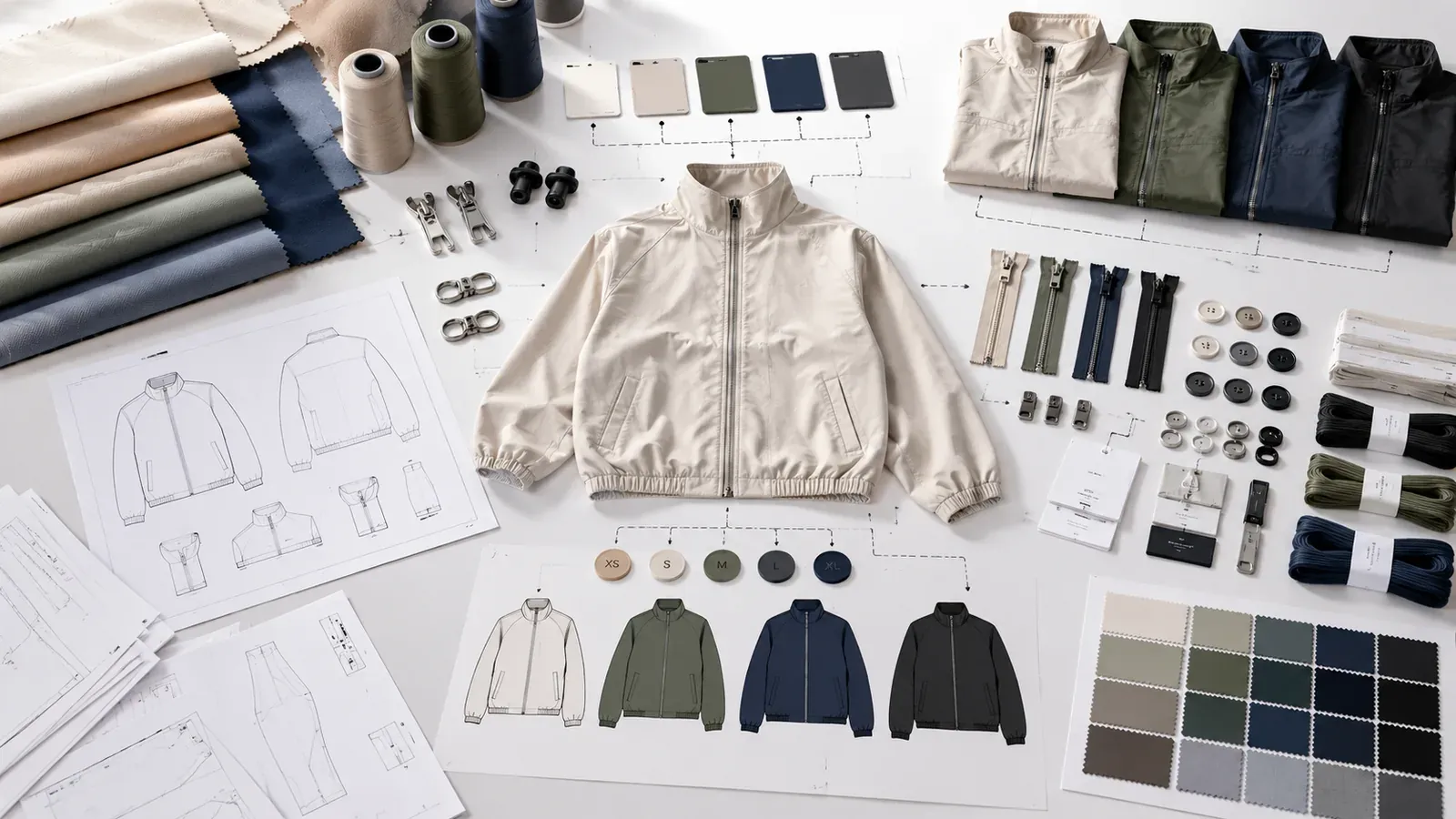
The short answer
A garment BOM can look complete and still be wrong enough to disrupt the order.
The problem is rarely an empty material line.
It is a believable BOM carrying the wrong consumption, colour-size mapping, substitute, wastage assumption or revision.
Once purchasing acts on it, a product-data problem becomes inventory, shortage, excess or margin loss.
Epicor provides the enterprise-grade ERP foundation for purchasing, inventory, approvals and finance. Epicor Venus adds the garment-specific style and BOM structure that links product decisions with the material combinations bulk production actually needs.
This is one part of the wider control problem described in From Sample to Shipment: Where Does Garment Manufacturing Lose Operational Control?: product definition has to survive the handoff into material commitment and execution.
One style can behave like dozens of material products
A style looks singular in merchandising.
Production sees combinations.
Colours.
Sizes.
Country labels.
Packaging variants.
Buyer-specific trims.
Potential substitutions.
The BOM therefore has to do more than say “this style uses this material.”
It needs to express which component applies to which production combination.
That is where simple BOM logic begins to strain.
A zipper may change by size.
A thread may change by colour.
A label may change by market.
A packaging component may apply only to selected SKUs.
The total order can be fully supplied in aggregate and still be short in the exact combination the factory needs.
That is one of the most frustrating forms of material shortage because the warehouse appears healthy while production cannot complete the required mix.
The matrix becomes dangerous when it is treated as decoration.
Colour-size matrices often sit beside the BOM as reference.
Operationally, they are part of the material requirement.
If the matrix says one trim applies to navy but purchasing interprets the BOM at style level, the order can be wrong even when both records are individually “complete.”
The same problem appears when size-specific components are not carried through to requirement calculation.
The factory needs a BOM structure that behaves the way the order behaves.
That means material logic must survive the transition from style definition to actual SKU demand.
Otherwise the matrix becomes a visual document rather than an execution model.
Consumption is an assumption until cutting proves it
Garment costing often begins before all bulk conditions are known.
Fabric width may be estimated.
Marker efficiency may be assumed.
Shrinkage may not be final.
Wastage may be based on history.
That is normal.
The danger is when provisional consumption quietly becomes permanent because nobody revisits it.
A small difference per garment multiplies across the full order.
At low volume, the error feels trivial.
At scale, it becomes a shortage or excess worth real money.
BOM control should therefore make the maturity of consumption visible.
Is this an early estimate?
A confirmed bulk value?
An actual learned value from production?
Those states carry different levels of trust.
Revision control and BOM control are the same commercial story.
A BOM can be accurate today and wrong tomorrow.
The buyer changes a trim.
Technical changes a construction detail.
Fabric width changes.
A substitution is approved.
If the BOM does not move with the product definition, purchasing continues acting on yesterday’s truth.
This is why version control is not separate from material control.
The BOM is the point where product change becomes financial commitment.
A late change needs to answer two questions:
What does the style require now?
What has already been purchased against the previous version?
Both matter.
If the first replaces the second without preserving history, the business loses visibility of the exposure created by the change.
Substitution is not only a technical decision.
When required material is unavailable, factories often find alternatives.
A substitute may be technically acceptable.
It may also change cost, consumption, lead time, quality risk or buyer approval.
If the substitution is handled only as a material swap, the financial record can remain tied to the original assumption.
The physical garment may be correct while order economics drift.
That is why substitution belongs in both product and commercial control.
The factory needs to know what changed, why, whether buyer approval was required and what happened to cost and availability.
The decision should remain visible after the crisis passes.
Excess deserves the same attention as shortage
Shortage stops production and therefore receives immediate management attention.
Excess is quieter.
It consumes cash.
It occupies warehouse space.
It can become dead stock when colours, buyers or seasons do not repeat.
An inaccurate matrix can create excess and shortage at the same time.
The business may have enough total trim quantity and still be short in one size-colour combination while holding unusable stock in another.
That is why material accuracy should be judged against usable order coverage, not only total inventory.
BOM trust should increase as the order matures.
Early development will always contain assumptions.
The objective is not to eliminate them.
It is to reduce them deliberately as the order moves toward bulk commitment.
Approved sample.
Final consumption.
Confirmed colour-size mapping.
Final trims.
Agreed substitutions.
Every step should increase confidence.
If uncertainty remains close to purchase or cutting, management should be able to see exactly where it sits.
This is better than presenting the BOM as finished simply because every field contains a value.
A complete BOM and a trusted BOM are not the same thing.
Actual consumption should improve the next commercial decision.
Factories accumulate valuable production history.
If actual fabric usage repeatedly exceeds planned consumption for a product family, future assumptions should change.
If one trim generates consistent wastage, purchasing should learn.
If certain fabrics behave differently in cutting, costing should reflect it.
This closes the loop between execution and future estimating.
The organisation stops restarting from generic assumptions every season.
BOM accuracy improves not only because people check harder, but because real production evidence becomes part of future planning.
Order mix can change the material risk even when the BOM is correct
A style-level BOM can be accurate while the final order mix creates a different material exposure than expected.
If the buyer changes the size curve or colour ratio, demand for specific trims, labels or packaging can shift sharply.
The total order quantity may remain unchanged.
The material requirement does not.
This is one reason garment material planning needs to understand the order matrix, not only the style master.
A commercial change in the order mix should therefore trigger a material-impact view quickly.
Otherwise the business can discover too late that one variant is short while another is overbought.
BOM accuracy should be tested by downstream outcomes.
The strongest proof of BOM quality is not that the record passed an internal review.
It is that purchasing, cutting and production can execute from it without repeated correction.
If the same styles generate urgent replenishment, excess stock or frequent substitutions, the BOM process may be producing formally complete records that are operationally weak.
Management should look for those patterns.
How often does purchasing need a late correction?
How often does cutting discover consumption shortfall?
How much excess remains after the order closes?
Which product families create the largest material variance?
These outcomes help distinguish isolated mistakes from structural weaknesses in BOM governance.
That is where the business can improve the system rather than simply checking harder.
A trustworthy BOM also protects production sequencing
Material errors do not only create buying problems.
They can change the sequence in which the factory is able to produce the order.
If one colour is short on a size-specific trim, the line may have to switch to another colourway.
That creates extra changeover.
It can fragment cutting and sewing.
It may also disturb packing or shipment sequence.
A BOM problem therefore travels into capacity and delivery.
This is why management should not judge BOM quality only by purchase accuracy.
The real question is whether material definition supports smooth execution across the full order mix.
A weak matrix can force the factory to reorganise production around avoidable shortages.
That cost rarely appears in the BOM itself, but it is part of the consequence.
Where Epicor Venus fits in BOM accuracy
Epicor provides the enterprise-grade ERP foundation for purchasing, approvals, inventory and finance. Epicor Venus adds garment-specific style, colour-size, BOM and consumption structures that translate apparel product definition into material demand.
That relationship matters because the BOM is where product truth becomes enterprise commitment.
Epicor Venus provides the apparel operating context while Epicor supplies the purchasing, inventory and financial backbone beneath it. Explore Epicor Venus for garment and apparel manufacturing.
ACC helps apparel manufacturers translate colour-size, consumption and revision logic into an Epicor Venus operating model that purchasing and production can trust at scale.
Frequently asked questions
Can a complete BOM still be unsafe to buy against?
Yes. The values, combinations, version and consumption assumptions may still be wrong or provisional.
Why do colour-size matrices matter to material planning?
Because components can vary by colour, size, market or SKU combination.
Can a BOM create excess and shortage at the same time?
Yes. Wrong mapping can create too much of one variant and too little of another.
Why should actual consumption feed back into future BOMs?
Because production evidence can improve costing, purchasing and material assumptions on future styles.