

The MES Screen Is Installed. Are Supervisors Using It When Decisions Happen?
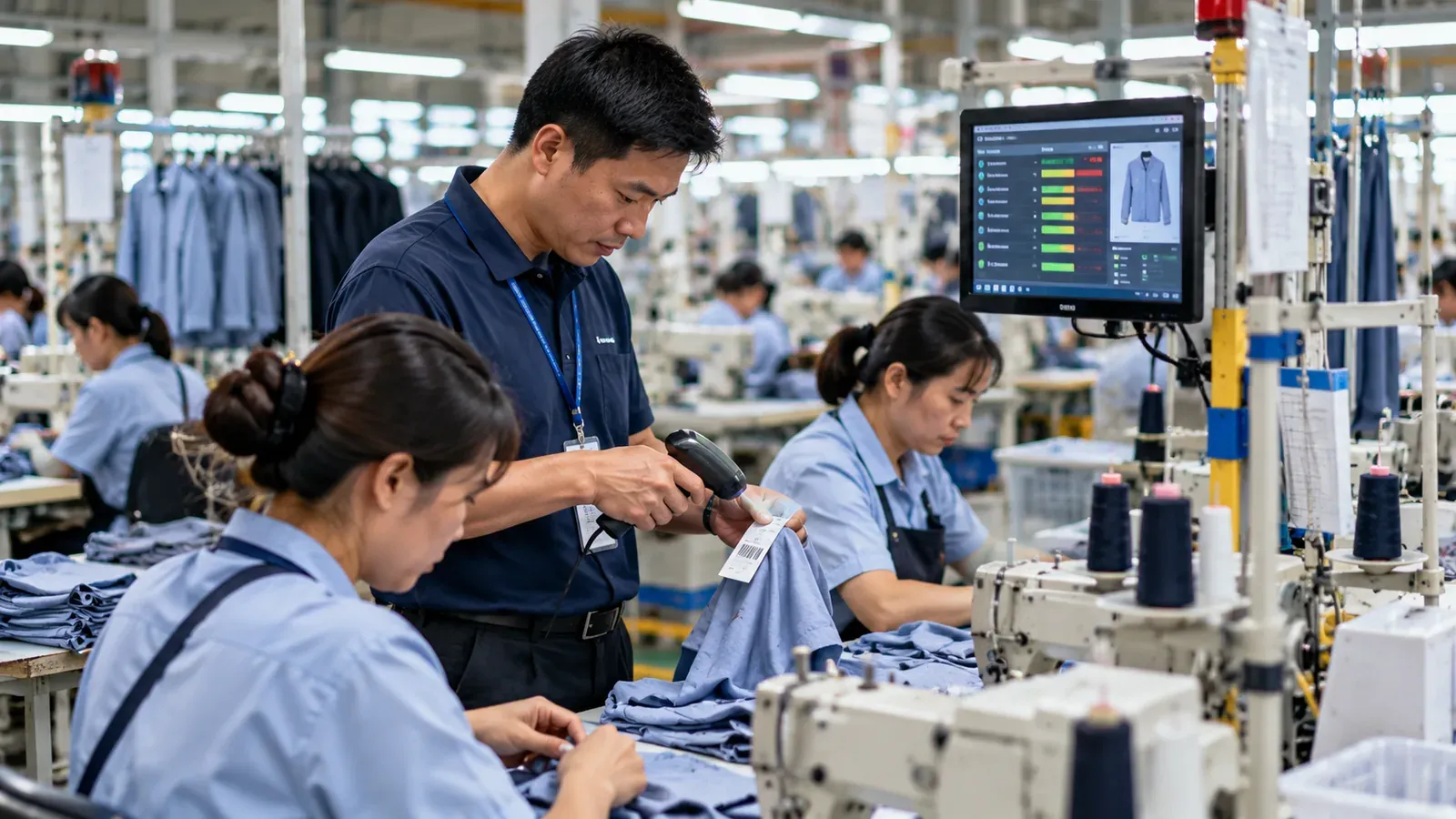
MES creates value when supervisors use live shopfloor information at the moment they rebalance work, react to bottlenecks, manage quality and protect delivery—not when data is entered later.
The short answer
MES adoption is successful when supervisors use current shopfloor information at the moment they decide how to rebalance work, respond to a bottleneck, contain a quality issue or protect a delivery. Installing terminals and collecting transactions is not enough if the information is entered late or supervisors still manage the line from paper and memory.
The practical goal is to make the digital record the easiest way to understand what is happening now. That requires useful event design, fast data capture, clear exception signals and operating routines that actually use the information.
The shopfloor adoption problem is central to ERP Is Live. How Do You Turn Garment Data Into Better Daily Decisions?: live information has little value if it arrives after the supervisor has already made the decision.
MES adoption is visible in decisions, not login counts
Login counts and transaction volumes are easy to track. They do not prove operational use.
A supervisor can log in every day, enter output at the end of the shift and still make every important decision offline.
Stronger adoption questions include:
- Was the bottleneck identified from live WIP/output data?
- Was a quality hold visible before more work passed the same point?
- Did the supervisor use current line performance to rebalance labor?
- Did planning see the actual production state before changing priorities?
These questions connect use to outcomes.
Late data can be accurate and still be operationally useless.
A correct transaction entered six hours late may be useless for intervention.
Shopfloor systems need to define which events are time-sensitive. Bundle movement, output, downtime, quality hold and completion can all lose operational value when recorded after the fact.
Not every event needs second-by-second capture. The required timing should match the decision window.
Data capture succeeds when it follows the way work already moves.
If scanning requires workers to leave the station, navigate multiple screens or enter data that the system already knows, users will delay or bypass it.
Good shopfloor design minimizes friction. Barcode/RFID, simple terminals, prefilled context and role-based screens can help, but technology must fit the factory's actual work sequence.
The process should not exist only because the software can capture it.
Supervisors need the few exceptions that change the next hour
A line supervisor does not need to watch every transaction.
The useful screen highlights deviation: operation falling behind, WIP accumulating, quality rejection rising, missing input, stalled bundle, machine issue or order running below the required completion rate.
Normal work should stay quiet. Exceptions should become visible early enough to act.
This mirrors the wider post-go-live principle: more data is valuable only when it reduces the time to a useful decision.
Quality should sit inside the production flow rather than beside it.
Quality events should not live in a separate world from production.
If defects are detected, the supervisor needs to know the affected operation, quantity, WIP location and potential delivery impact. Rework should be visible as work, not disappear from the performance picture.
This creates a more honest view of output.
The shopfloor should be able to challenge the plan with live evidence.
ERP planning often starts from standards and planned dates. MES provides actual execution evidence.
When the connection works, planners can see whether a line is truly recovering, whether an order is ahead/behind and whether a capacity assumption remains credible.
Without that feedback loop, the plan can remain optimistic while the floor tells a different story.
Standard work matters more than an attractive MES screen
Supervisors need a clear routine for how to use the information.
For example:
- start-of-shift readiness check;
- hourly/periodic flow review;
- bottleneck escalation rule;
- quality containment rule;
- end-of-shift handover.
The MES should support those routines. If it merely displays information without changing the routine, adoption will remain superficial.
Supervisors learn the system fastest when training follows real production decisions.
Generic button-by-button training is necessary but insufficient.
Supervisors learn faster when training is built around real situations:
- line falls 15% behind plan;
- WIP accumulates before one operation;
- defect rate rises;
- a critical bundle has not moved;
- an urgent order is inserted;
- overtime is being considered.
Teach users how the system helps them decide, not only where to click.
MES loses trust when people believe it exists mainly to watch them
If workers and supervisors believe the system exists mainly to punish individuals, they may resist or manipulate data.
Management should communicate the operational purpose: reduce hidden problems, improve flow, support fairer decisions and make recovery earlier.
Where Epicor Venus connects MES reality back to the garment order
Epicor provides the enterprise-grade ERP foundation for orders, resources, inventory, purchasing and finance. Epicor Venus adds the garment-specific routing, line, WIP, quality and production context that allows shopfloor events to remain connected to the order and delivery promise they affect.
ACC helps manufacturers shape the operational use of that information—what a supervisor needs to see, when the event should be captured, and how the live signal should feed planning. The goal is not more MES activity; it is better decisions while the shift is still running. Explore Epicor Venus for garment and apparel manufacturing.
The strongest adoption signal is whether the live view has replaced parallel manual control.
Track a few behaviors:
1. percentage of time-critical events captured within the required window;
2. number of management decisions supported by live MES evidence;
3. reduction in end-of-shift manual reconciliation;
4. exceptions detected before the planned completion is missed;
5. supervisor use of system evidence in daily meetings;
6. recurring bypasses or manual workarounds.
These measures are more meaningful than raw login counts.
The value of shopfloor feedback falls quickly when it waits for month-end.
Shopfloor adoption becomes valuable when information returns quickly enough to change the same shift. If a quality issue is captured at 10:00 but only reviewed after production closes, the system has recorded history rather than supported control. Supervisors need signals that are timely enough to rebalance work, investigate a bottleneck, contain a defect, or adjust the next bundle.
That requires clear ownership of data capture. Not every operator needs to enter data directly, but every critical event needs a reliable capture point. The business should know who records completion, who records downtime, who records rework, and who verifies the exception. Ambiguous ownership creates gaps that later appear as “system accuracy problems.”
Adoption should also be measured by the disappearance of parallel processes. If supervisors still maintain separate whiteboards or spreadsheets for the same decisions, understand why. Sometimes the system view is too slow, too broad, or missing the exact operational sequence used on the floor. Those gaps should feed a controlled improvement backlog.
A mature MES environment therefore looks less like more screens and more like fewer reconciliations. Teams trust the live record because it helps them act, and the office receives a more credible picture because the data originated where the work happened.
Trust grows when the system repeatedly matches physical reality
Supervisors will only rely on MES if the screen reflects the factory they can physically see. When reported WIP, downtime or completed quantity repeatedly differs from reality, experienced supervisors naturally return to paper notes and verbal checks.
Trust improves when discrepancies are treated as process issues to be corrected quickly. If scanning is skipped because the station layout makes it inconvenient, redesign the capture point. If one operation is frequently recorded late, clarify ownership. If rework is invisible, define a proper rework event instead of asking teams to force the quantity into a normal completion status.
It is also important to keep the line view concise. Supervisors need current priorities, blocked work, abnormal WIP, quality exceptions and the next action. They do not need every ERP field on the shopfloor screen.
When the live view consistently helps the supervisor answer “what needs attention now?”, adoption becomes self-reinforcing. Data quality rises because the tool is part of the work rather than an additional reporting task.
Frequently asked questions
Does every operator need to use MES directly?
Not necessarily. The capture design can vary by process. The important point is that operational events are recorded accurately and quickly enough for the decision process.
Is real-time data always necessary?
No. "Real-time" should match the decision window. Some events need immediate capture; others can be updated periodically without losing value.
Why do supervisors keep spreadsheets after MES launch?
Often because the spreadsheet provides context, sequencing or exceptions that the standard screen does not. Investigate the need before banning the workaround.
Should MES data feed ERP planning?
Yes, where relevant. Actual execution should inform planning, order status and recovery decisions rather than remain isolated on the shopfloor.
Reporting gaps often reveal workflow problems, not user failure
When event capture is late or missing, record the reason. The cause may be device availability, network issues, confusing workflow, duplicate entry or unclear responsibility. Treat recurring capture problems as process-design feedback.
If management responds only by demanding more compliance, the factory may produce cleaner timestamps without more trustworthy operations. Fix the friction that creates the delay.
The real test is whether the floor makes faster and better corrections
The adoption test is physical: compare the live MES view with what the supervisor can see on the floor during a real exception. Does the system expose the same bottleneck, WIP or quality issue early enough to act?
Where the live view and floor diverge, fix the capture or workflow and test the same type of event again. Trust grows when the digital view repeatedly matches production reality.