

That Pile Between Sewing Operations Is Already Writing Tomorrow’s Schedule
Work-in-progress is not passive inventory. Its location, age and imbalance reveal where tomorrow’s output is already being constrained.
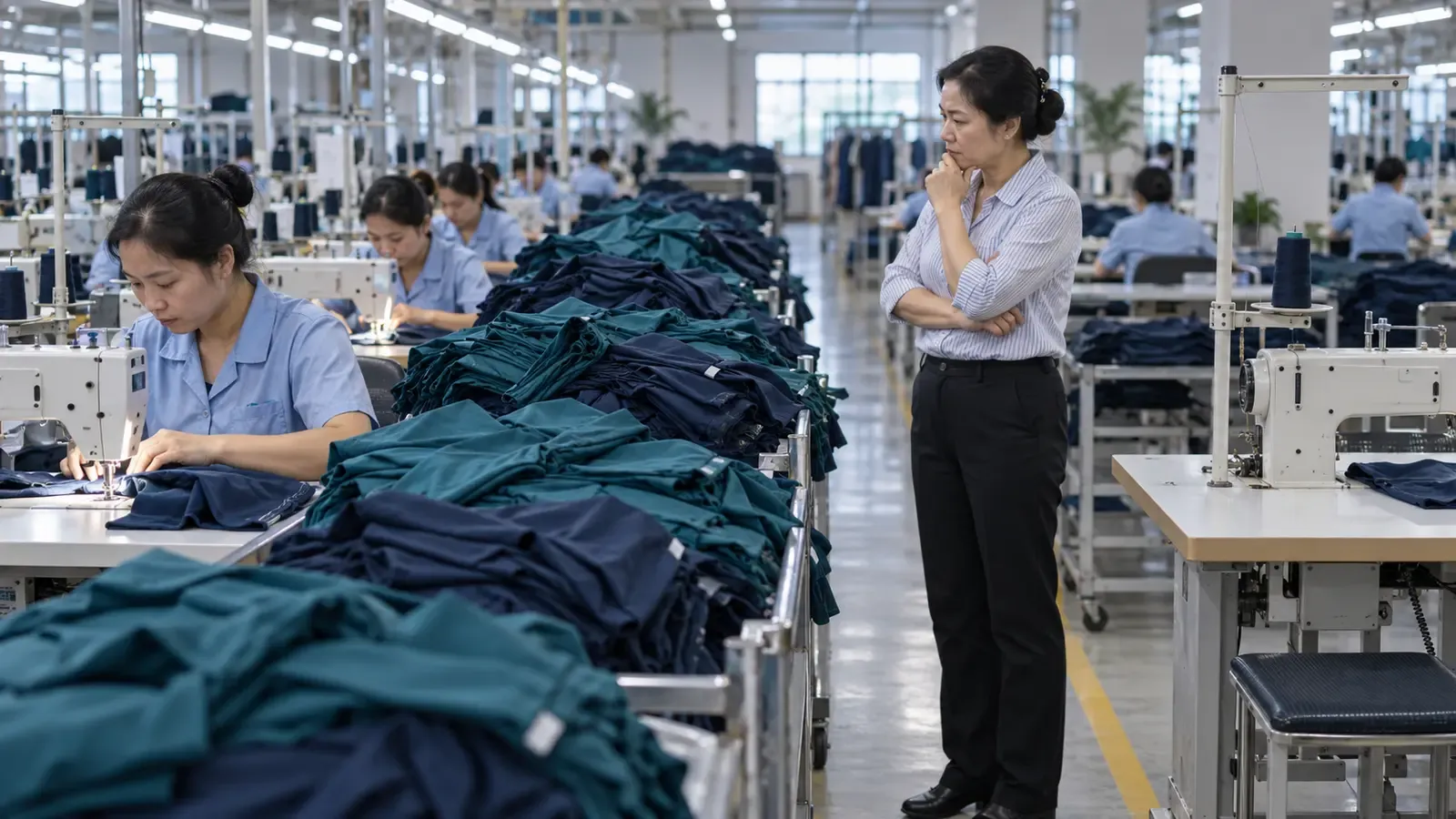
The pile looks reassuring from the end of the line. Bundles are everywhere. Nobody is waiting for work, machines are active and the floor appears full of production.
But one operation has six hours of pieces stacked beside it, while the next two operators are working from a nearly empty trolley. A pocket process is producing faster than assembly can absorb. Finishing has yesterday’s sizes but not today’s complete ratio. The factory is busy, yet tomorrow’s output is already being decided by where the piles sit.
Work-in-progress is not only inventory. It is the physical shape of flow.
The short answer
Garment WIP control means knowing the quantity, identity, location, age and next operation of work between production stages, then using that evidence to maintain balanced flow. Managers should set practical WIP limits, expose ageing and blocked bundles, measure accepted—not merely processed—output and resolve the constraint creating the queue.
The objective is not zero WIP. It is enough controlled work to protect continuity without hiding delay, imbalance or quality risk.
Why piles feel productive
WIP offers local security. Operators have something to sew. Supervisors can keep people occupied. A process can continue even if the next stage is temporarily slow. In variable garment operations, a small buffer may be necessary.
The danger is that every operation protects itself. Upstream teams keep producing to avoid idle time, and material accumulates before the constraint. Local utilisation rises while total lead time grows.
The line can therefore look efficient by activity and perform poorly by completed, accepted garments.
Five facts every bundle should carry
Identity
Order, style, colour, size range, cut or work order and relevant material lot.
Quantity
What entered, what was processed, what was accepted and what remains.
Location
The current operation or controlled holding point.
Time
When it entered the location and when it last moved.
Condition
Ready, processing, waiting, on hold, under repair or awaiting inspection.
Without these facts, management sees fabric and pieces but cannot tell whether they are available progress or hidden delay.
Age can be more important than quantity
A large, fresh buffer before a stable operation may be less concerning than a small bundle that has not moved for two days. Age reveals obstruction.
Create age bands appropriate to the process. Highlight work that exceeds its expected dwell time. Then ask why: missing parts, quality hold, unclear instruction, machine problem, priority change, unbalanced capacity or lost identity.
Do not let ageing become another coloured report. Each aged bundle should have a reason, owner and next action.
Read the line as a landscape
Walk from final output backward. Where is the first point starved of work? Where is the largest queue? Which operation is frequently blocked or sending repairs backward? Which sizes or colours are missing from otherwise complete sets?
The constraint may move during the day as skill, material mix and quality conditions change. A static line balance prepared before production is a hypothesis; WIP shows what the live system is doing.
This is why The Waiting Factory treats queues as part of lead time. A garment can spend more elapsed time beside an operation than under the needle.
The ratio trap
Total pieces can conceal incomplete assortments. A shipment or downstream process may require balanced colour-size ratios, but one operation produces easy sizes faster. The floor reports high output while complete sets wait for the missing sizes.
Track WIP against the order structure. Show whether bundles can form the next required unit—complete cut, size set, packing ratio or shipment—not simply how many pieces exist.
This connects production progress to the commercial promise rather than to an undifferentiated piece count.
Quality changes the meaning of WIP
Work awaiting inspection or repair is not equivalent to accepted work ready for the next operation. If all three states share one number, the line can appear healthy while defects accumulate.
Separate processed, inspected, accepted and repair quantities. Mark the defect or hold reason without losing bundle identity. When a process problem appears, contain affected work quickly so the queue does not multiply the same condition.
Final Inspection Is the Most Expensive Time to Discover a Process Problem explains why quality evidence must enter the flow before thousands of pieces reach the end.
Set limits that trigger a response
A WIP limit should reflect the variability and protection a process genuinely needs. When the limit is reached, upstream work should not simply continue creating more inventory. The team investigates the constraint, reallocates support, changes sequence or accepts a managed exception.
Limits can be expressed in pieces, bundles, hours of work or a combination. Hours often make comparison easier because 200 simple components and 200 complex assemblies represent different workloads.
The limit is not a punishment. It is a signal that the line’s internal agreement has broken.
A morning example
At 9:00, the dashboard shows output near plan. The WIP view shows twelve hours before collar setting, thirty minutes before side seam and a growing repair queue after topstitching. If the line continues unchanged, operators after collar setting will soon starve while upstream output expands the pile.
Management can move a skilled operator, correct the method, change the feeding sequence or temporarily slow upstream work. The important point is timing: WIP makes the future condition visible before final output falls.
What connected execution contributes
ACC presents Venus and connected manufacturing capabilities across garment order, production and shop-floor operations. See the official Venus overview for current scope.
Digital events can record movement, completion, quality condition and time against controlled work identities. Management can view WIP by order, operation, age and status rather than relying only on a physical walk or end-of-day total.
Technology should not demand excessive scanning that slows work. Choose meaningful transition points and use labels or barcodes where they provide decision value. The best data design is detailed enough to expose flow and simple enough to remain accurate.
Measures for flow, not activity
Use:
- accepted throughput at the end of the flow;
- WIP quantity and equivalent hours by operation;
- median and maximum WIP age;
- blocked or held bundles by reason;
- ratio completeness;
- time to first accepted output after input;
- repair loops and repeat constraint locations;
- total production lead time from cut release to finished acceptance.
Do not celebrate lower WIP if operators are starved because material or instruction is unreliable. Read continuity, throughput and quality together.
Frequently asked questions
What is WIP in garment manufacturing?
Work-in-progress is material or partially completed garments that have entered production but have not yet reached the defined finished state.
Is high WIP always bad?
No. Some buffer can protect flow from normal variation. Excess or ageing WIP becomes harmful when it hides constraints, lengthens lead time or multiplies quality exposure.
How should a factory measure WIP?
Measure quantity, equivalent workload, identity, location, age and condition. Pieces alone may not describe the time or completeness represented.
What is an appropriate WIP limit?
It depends on operation variability, replenishment reliability and the protection required. The limit should be explicit and trigger action when exceeded.
Can WIP predict tomorrow's output?
It can reveal likely starvation, blockage and imbalance. Prediction improves when WIP is connected to required operations, accepted rates and remaining order structure.
The pile is speaking
Every pile contains a message about the line. It may say the next operation is under-capacity, the method is unstable, quality has stopped flow, priorities changed or identity was lost.
The message becomes useful when WIP is visible as time and condition, not merely material. Control the amount, watch the age, preserve the order structure and respond at the constraint.
Then the floor no longer needs tomorrow’s missed output to explain what today’s pile already knew.
Give every overflow a destination and an expiry
When a WIP limit is exceeded, teams need a defined response. Mark the affected operation, stop feeding more work where appropriate, and decide whether to rebalance people, repair equipment, clarify quality or change the sequence. A pile moved to a hidden corner is not resolved.
Temporary overflow should carry an owner and review time. If it remains after the constraint clears, ask why the downstream pull did not resume. This simple discipline prevents yesterday’s exception from becoming today’s accepted layout.
Use the empty space as information
The absence of WIP can also be a signal. A downstream operation with no bundle may indicate starvation, late transport, poor balance or an upstream quality hold. The goal is not to keep every buffer full. It is to maintain enough controlled work for flow while making abnormal excess and abnormal emptiness equally visible.