

How Much Paper or Board Will the Job Really Consume?
Material cost depends on more than finished quantity. Imposition, trim, grain, sheet size, makeready, spoilage, minimum purchases and finishing waste determine the real material requirement.
The short answer
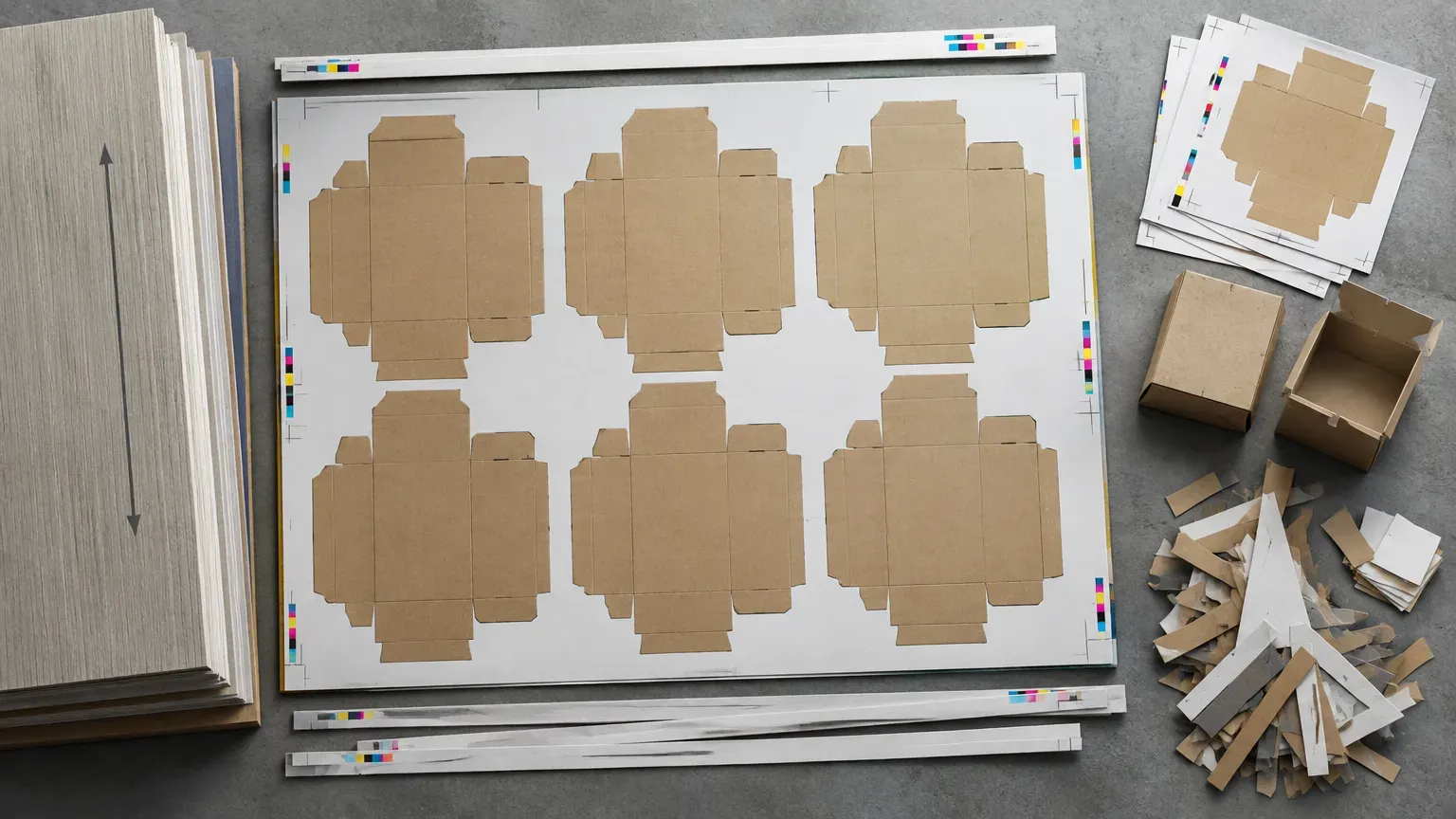
The real material requirement for a printing or packaging job is determined by the production layout and expected process loss, not only by finished quantity. Imposition, trim, grain direction, sheet or reel size, makeready, spoilage, finishing yield, inspection samples and supplier minimums can all change how much paper, board or film must be purchased and issued.
Material estimating should therefore calculate a gross requirement from the intended route and then compare actual consumption with that assumption after production.
How this connects to the pillar
The wider profitability model is covered in The Quote Won the Job. Will the Job Still Make the Margin You Expected?. Material yield is often one of the largest drivers of quote-to-actual variance.
Start with imposition
The finished unit must fit the parent sheet, board or web efficiently.
A small change in dimensions can alter how many units fit.
The estimator should know the intended imposition because that determines the gross sheet requirement.
For packaging, dieline shape and orientation can make this especially important.
Respect grain and direction
The mathematically best layout may not be technically valid.
Grain direction can affect folding, creasing or structural performance.
Film orientation, print direction or finishing feed direction can create similar constraints.
Yield calculations should use layouts production can actually run.
Include trim and unusable areas
Press gripper, color bar, registration, die margin and finishing requirements can reduce usable area.
These allowances belong in the material model.
If the estimate uses only finished dimensions, material cost can be understated before waste is even considered.
Separate geometric loss from process waste
Geometric loss comes from layout and trim.
Process waste comes from setup, control, defect and spoilage.
Keeping them separate helps management identify improvement opportunities.
Better imposition reduces one category.
Better process control reduces another.
If both are merged into one waste percentage, learning becomes harder.
Estimate makeready sheets deliberately
Press setup needs material before saleable production begins.
The amount can vary by:
- machine;
- color count;
- substrate;
- job complexity;
- proof standard;
- operator/process maturity.
Finishing operations may also require setup pieces.
Use process-specific allowances where the difference is material.
Include downstream spoilage
A sheet that passes printing can still be lost in lamination, die-cutting, folding, gluing or packing.
If finishing loss is recurring, the estimate should reflect it.
Do not place all waste responsibility on press performance.
The job route should identify where yield can fall.
Model supplier sheet or reel options
The same substrate may be available in several sizes.
A slightly higher material price may produce better yield.
A cheaper standard sheet can create more trim.
Compare total job material cost rather than unit price alone.
This can support better purchasing decisions too.
Account for supplier minimums
Short runs can be affected by minimum purchase quantity.
The job may need less material than the supplier will sell.
Management then needs a policy:
- charge the full purchase;
- carry residual stock;
- share material across jobs;
- use a different source.
The estimate should reflect the actual economic treatment.
Treat overs consciously
Customers sometimes expect over-delivery tolerance.
Production may also need an internal overrun to protect final quantity after finishing.
Define how overs are estimated.
Too little can cause reruns.
Too much creates unnecessary material and inventory.
Use actual history by job type.
Track remnant value realistically
Unused sheets or reel remnants may have value if they can be reused.
They may be worthless if customer-specific, odd-sized or difficult to store.
Do not automatically credit all residual material back to the job.
Use a realistic rule based on whether the material becomes usable inventory.
Include sample and inspection material
Press approvals, lab tests, destructive testing and customer samples consume material.
These quantities can be small, but high-value substrates or short runs can make them meaningful.
Include them where they recur.
Compare planned and actual yield
After completion, calculate actual consumption per saleable unit.
Then ask why it differed:
- imposition;
- unexpected setup;
- press spoilage;
- finishing loss;
- quality rejection;
- overproduction;
- rerun;
- material defect.
The cause matters more than the total percentage.
Use yield history by process family
One universal waste factor is easy to maintain but often inaccurate.
Group similar work by relevant drivers:
- press;
- substrate;
- job length;
- number of colors;
- finishing route;
- structural type.
Use history to create practical bands rather than a unique factor for every possible job.
Watch for hidden yield loss in WIP
Material can be consumed without being recorded as scrap if partially processed sheets remain in work in process or are discarded later.
Accurate material issue and scrap capture improve the estimate feedback loop.
The physical and system records should tell the same story.
What management should measure
Useful indicators include:
- estimated versus actual material quantity;
- geometric yield;
- press spoilage;
- finishing spoilage;
- material variance by substrate;
- rerun consumption;
- residual stock from minimum purchase;
- repeat jobs with persistent yield variance;
- yield by job family.
These measures help separate estimating error from production performance.
ACC and Jupiter context
Jupiter connects printing and packaging material planning with job specification, production and costing. That makes material yield easier to manage as a job-level economic assumption rather than a generic purchasing percentage. Explore Jupiter for printing and packaging.
Operational review point
Select five jobs with the highest material-cost variance.
Rebuild the material bridge:
1. planned finished quantity;
2. planned imposition;
3. geometric loss;
4. planned setup/spoilage;
5. actual material issued;
6. actual good output;
7. scrap and residual stock.
Then identify which assumption failed.
Include make-up quantity after finishing
The amount printed may need to exceed the customer quantity enough to survive all later processes.
Estimate backward from required packed good quantity through expected finishing yield.
This prevents the press from producing exactly the customer quantity and leaving finishing with no allowance for normal loss.
The logic is particularly important where late reruns are expensive.
Review material price together with yield
A cheaper substrate can cost more per good unit if yield is worse.
Compare cost per saleable output, not only cost per sheet or kilogram.
This is also useful when choosing between supplier sheet sizes or reel widths.
Purchasing and estimating can make better decisions when price and yield are connected.
Treat different versions as separate yield events where necessary
Several artwork versions may share one substrate but require separate setup and overrun.
If the estimate calculates material only from total quantity, it may understate spoilage for a multi-version order.
Model the number of versions where it materially affects setup sheets or finishing loss.
Include damaged or rejected incoming material
Production waste is not the only source of material loss.
Supplier defects, transit damage or unusable sheets can affect the job.
Where this risk is material, capture the actual cause separately from process spoilage.
That allows purchasing to address supplier performance without inflating the production waste standard.
Use remnants intentionally
Residual material can be valuable when the plant can identify and reuse it.
A remnant policy should define minimum usable size, storage, identification and reservation.
This turns some apparent yield loss into future inventory value while avoiding a warehouse full of fragments nobody can confidently use.
Compare yield across equipment choices
The same job may fit more efficiently on one press or converting line than another.
A machine with a lower hourly rate is not automatically cheaper if sheet format creates poor yield.
Estimating should consider the combination of machine rate, throughput and material utilization.
This becomes especially important for jobs with expensive board or film.
Review overproduction as a hidden material cost
Plants sometimes produce extra units “just in case.”
A small buffer can protect final quantity, but uncontrolled overproduction consumes material and capacity.
Compare planned overrun with actual finished excess.
If the same job family regularly finishes far above ordered quantity, tighten the overrun assumption or process control.
Frequently asked questions
Is one waste percentage enough?
It can work for simple operations, but process-specific or job-family assumptions usually provide better control where waste varies materially.
Should unused material reduce the job cost?
Only according to a realistic inventory policy. Reusable residual stock is different from customer-specific or unusable remnant.
Is better material yield always the goal?
Not at the expense of quality or production stability. The objective is economic and technically valid yield.
Can imposition decisions affect selling price?
Yes. Layout efficiency can materially change substrate requirement and therefore job cost.