

The 9 A.M. Production Meeting a Connected Factory Shouldn’t Need
The daily status meeting often exists to reconstruct yesterday. Connected production data changes it from a reporting ritual into a short decision forum.
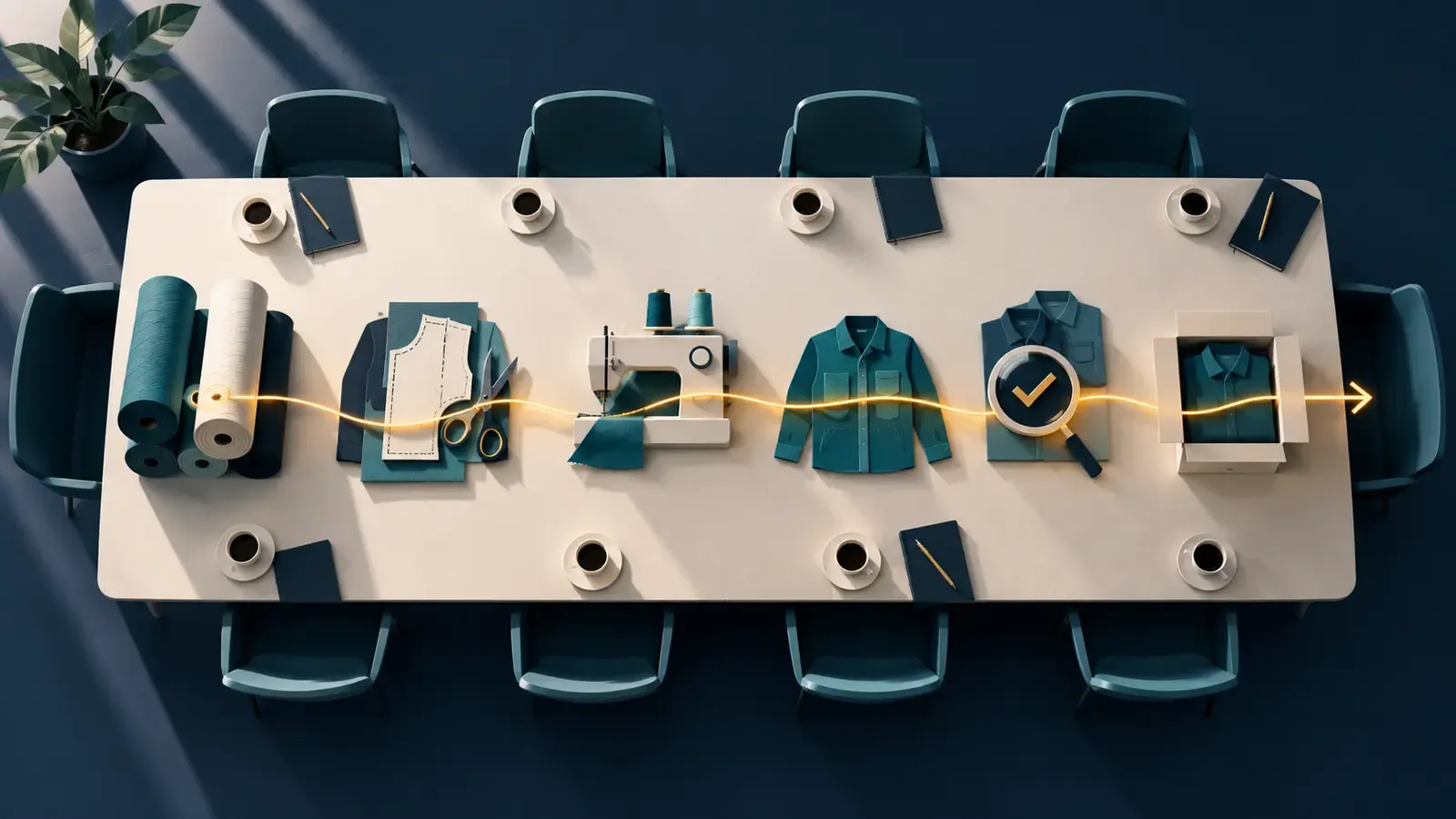
At 9 a.m., twelve people bring twelve pieces of yesterday into a room. A supervisor has handwritten output. Quality has a separate rejection count. Planning has the official target. Merchandising has a buyer priority that changed after the plan was printed.
The first half of the meeting is not management. It is data assembly.
The short answer
A connected garment factory should not need a daily meeting to discover basic production status. Output, work-in-progress, quality events and constraints should already be visible from shared operational records. The meeting can then focus on exceptions, decisions and owners rather than reconstructing what happened.
The reconstruction tax
Manual status collection has a cost beyond meeting time. Numbers arrive at different cut-offs, use different definitions and lose context. A completed piece may mean sewn, inspected or packed. A line may hit target by creating a queue at the next operation. By the time the figures agree, the opportunity to respond may have narrowed.
This tax is paid daily by supervisors, planners, quality teams and merchandisers. It also teaches the organisation that information becomes official only when a meeting accepts it.
Replace the report, keep the decision forum
The right goal is not “no meetings.” It is a different agenda. Before the meeting, the system should reveal where actual flow differs from plan. During the meeting, people should decide what to do.
A useful exception agenda asks:
1. Which order or operation moved outside tolerance?
2. What evidence explains the gap?
3. What delivery, quality or margin consequence is emerging?
4. What decision is required now?
5. Who owns the action and when will its effect be visible?
If no decision is required, the item may not need meeting time.
What live production visibility must connect
Shop-floor data becomes valuable when it is linked to the order and plan. A standalone output count cannot explain whether the right colour-size quantities were made, whether accepted quality is sufficient or whether the remaining work fits the shipment date.
ACC includes production and shop-floor visibility among the garment-industry functions described for Venus. In practice, visibility should connect line input, output, work-in-progress and quality to the commercial order and production schedule.
Design signals people will trust
More frequent data is not automatically better data. Operators and supervisors need clear event definitions, simple capture and visible correction rules. Managers need to know the cut-off, source and owner. When an automated or scanned event is unavailable, a controlled manual entry is better than invisible improvisation.
Trust grows when the system helps the factory, not only headquarters. A line leader should see a constraint earlier; quality should avoid duplicate recording; planning should spend less time chasing. Adoption is an operating benefit, not a communications campaign.
This article belongs to the connected-operations series led by Inside the Invisible Factory. For cross-site comparison, continue with When Two Factories Both Say ‘On Schedule’.
A better 20-minute agenda
The redesigned meeting can be brief. Spend the first few minutes confirming only material changes since the previous review. Use the next block for exceptions that cross functions—material, quality, capacity or buyer priority. End with decisions, owners and the next observable event that will confirm whether the action worked.
Do not invite a department merely to read its report. Invite the owner of a decision or dependency. Keep the detailed investigation outside the main forum, but link its outcome back to the order and exception. Over time, recurring agenda items expose process weaknesses that deserve permanent correction.
From daily meeting to continuous management
When information is visible throughout the day, intervention need not wait until morning. A material release can update readiness. A quality hold can change accepted output. A rate loss can change expected completion. The responsible people see the consequence at the event’s natural time.
That does not mean managers watch screens constantly. Alerts need thresholds, escalation rules and quiet periods. The goal is attention by exception: less noise for stable work, faster coordination for conditions that can still be changed.
Define the production events first
Technology cannot resolve an ambiguous event. Teams must agree when work is counted as input, completed, accepted, held, reworked and packed. They must decide how partial bundles, repairs and transfers affect quantity. These definitions are operational policy.
Start with a small set that supports real decisions. Capture at the point closest to the event, then make correction visible rather than silently overwriting history. If data arrives late, show its timestamp so users understand the limits of the view.
Once definitions are stable, automation can reduce effort. Barcode, terminal, machine or other capture methods may help, depending on the environment. The design criterion is not novelty. It is whether the event becomes timely, accurate and useful without burdening the operator.
Avoid the theatre of real time
A screen that refreshes every second can still display an outdated plan or misunderstood quantity. Leaders should ask what decision becomes better at each level of freshness. A safety or quality signal may require immediate attention. A capacity forecast may be useful at a slower rhythm.
This question controls noise and cost. It also prevents the organisation from equating motion on a dashboard with control on the floor.
Measure whether the meeting changed
After implementation, do not celebrate only data availability. Measure preparation time, time spent reconciling figures, age of exceptions at detection, closure of agreed actions and recurrence of the same issue. Observe whether supervisors spend more time at the source of flow and less time producing reports.
The strongest sign is conversational: people stop debating whose number is correct and begin debating which response is best.
Frequently asked questions
What is shop-floor production visibility?
It is a timely, order-linked view of production events such as input, output, work-in-progress, quality status and constraints.
Does real-time data guarantee better decisions?
No. It must be accurate, contextual and tied to clear ownership. Faster ambiguity is still ambiguity.
Which meeting should remain?
Keep the forum that resolves cross-functional exceptions and makes trade-offs. Remove repeated recitation of information people can review beforehand.
The connected factory does not silence its managers. It gives them a better first question at 9 a.m.: “What decision do we need to make?”
Define production events first
Technology cannot resolve an ambiguous event. Teams must agree when work is counted as input, completed, accepted, held, reworked and packed. They must decide how partial bundles, repairs and transfers affect quantity. These definitions are operational policy.
Start with a small set that supports real decisions. Capture at the point closest to the event, and make correction visible rather than silently overwriting history. If data arrives late, show its timestamp so users understand the limit of the view.
Once definitions are stable, automation can reduce effort. Barcode, terminal, machine or other capture methods may help, depending on the environment. The design criterion is not novelty. It is whether the event becomes timely, accurate and useful without burdening the operator.
Avoid the theatre of real time
A screen refreshing every second can still show an outdated plan or misunderstood quantity. Ask what decision becomes better at each level of freshness. A quality signal may need immediate attention; a capacity forecast may work at a slower rhythm. This controls noise and cost and prevents motion on a dashboard being mistaken for control on the floor.
After implementation, measure preparation time, time spent reconciling, age of exceptions at detection, action closure and recurrence. Observe whether supervisors spend more time at the source of flow and less time producing reports. The strongest sign is conversational: people stop debating whose number is correct and begin debating which response is best.
A simple transition plan
For two weeks, keep the existing meeting but record every number participants must collect manually and every disagreement about meaning. Choose the few data points that support the most decisions, define them and connect them to the relevant order and operation.
Next, send the shared exception view before the meeting. Ask participants not to recreate the whole report; they should arrive ready to challenge an exception or propose an action. Track which manual reports remain necessary and why. Some will expose missing context worth adding. Others will survive only through habit.
Finally, shorten the agenda and move detailed problem-solving to the responsible group. Preserve a decision log tied to the exception and review whether the chosen action changed the expected outcome. The meeting becomes smaller because the operating loop becomes stronger, not because management simply demands fewer slides.