

The Print Is Good. Why Do Quality Problems Appear in Finishing?
Lamination, coating, foil, folding and gluing can expose defects created by upstream conditions or introduce new ones. Quality must account for process compatibility, not only each machine in isolation.
The short answer
Lamination, coating, foil, folding and gluing can expose defects created by upstream conditions or introduce new ones. Quality must account for process compatibility, not only each machine in isolation.
Finishing is where hidden incompatibilities become visible
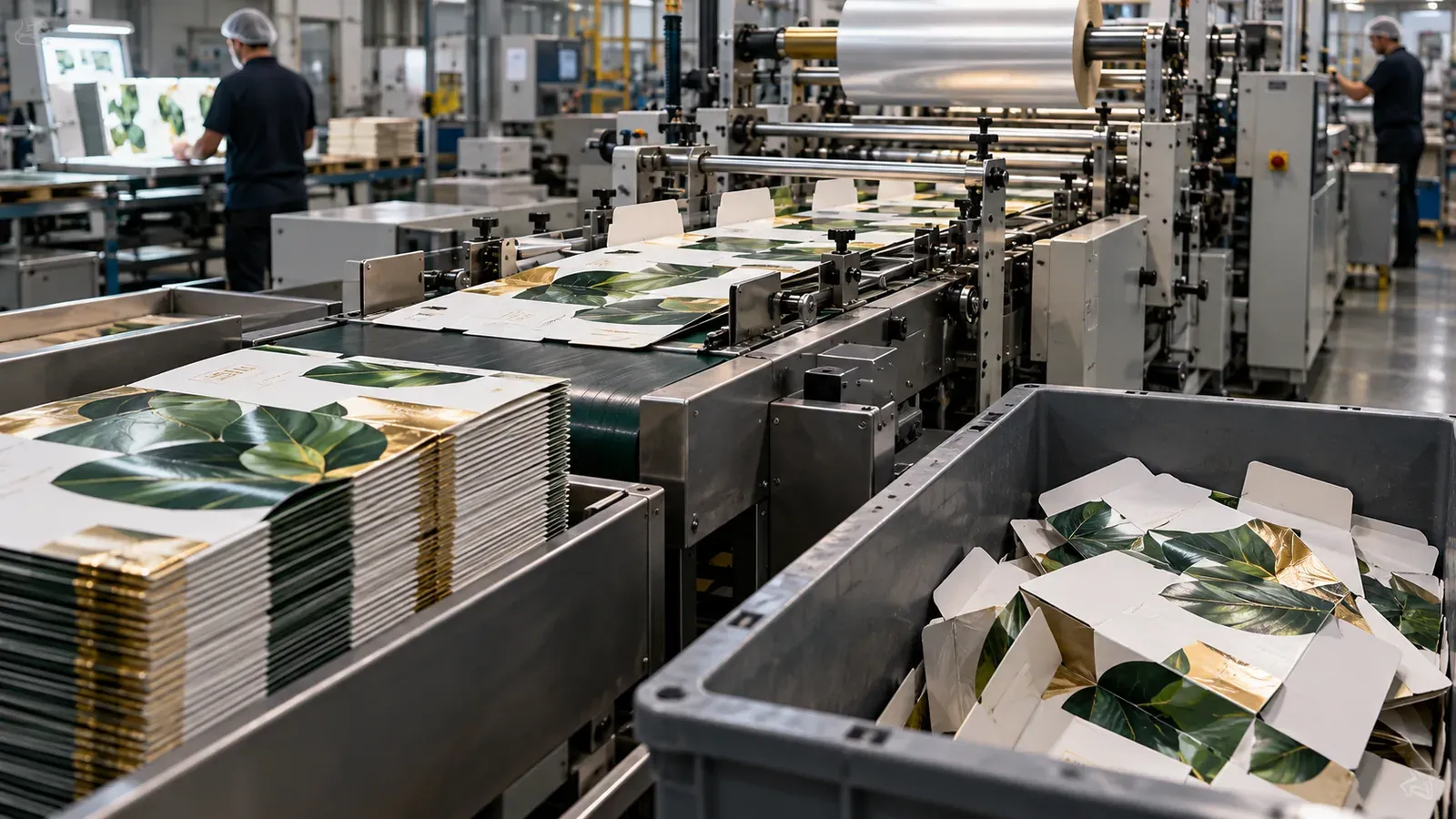
A printed sheet can pass press inspection and still fail when laminated, coated, foiled, folded or glued. The finishing machine may be operating correctly; the problem may be ink cure, surface energy, grain direction, coating interaction, board stiffness or insufficient conditioning time. Finishing therefore acts as a test of how well upstream choices work together. Quality planning should identify these dependencies before the job reaches the final processes.
Cure and conditioning time are part of the routing
Production schedules often show machine time but ignore the waiting time required for material to stabilise or ink and coatings to cure. When downstream work begins too early, the factory may see scuffing, blocking, adhesion failure, cracking or appearance change. These defects can look like finishing problems even though the schedule created the condition. Treating required waiting time as a real routing constraint helps protect both quality and delivery reliability.
Lamination and coating change the surface system
Adhesion depends on the interaction between substrate, ink, coating, adhesive, temperature and pressure. A material substitution or press adjustment can therefore affect a finishing process that has not changed. When lamination bubbles or coating defects appear, the investigation should check the complete surface history rather than only the finishing settings. Job records that preserve material and press conditions make this analysis faster.
Folding exposes grain, crease and print interactions
Cracking or poor folds can be caused by board grain, inadequate creasing, heavy ink coverage, coating or the relationship between design and fold direction. A folding operator may be able to reduce the symptom, but the permanent solution may belong in structural design or material selection. Repeat jobs should therefore capture the cause so that estimating, planning and prepress can improve the next production standard.
Glue performance depends on more than the glue unit
Weak bonds may result from adhesive condition, surface coating, dust, varnish, temperature, compression time or carton design. Adjusting adhesive quantity alone can increase cost and create mess without solving the real cause. A controlled response checks the bond surface and process history first. This is another example of why finishing quality needs cross-process evidence rather than isolated machine troubleshooting.
Inspect at the stage where the characteristic becomes meaningful
Some features cannot be judged properly on a flat printed sheet. Fold alignment, foil position, laminate appearance, glue bond and carton geometry become meaningful only after the relevant process. The quality plan should therefore place checks at the stage where each critical characteristic exists. Final inspection remains important, but earlier in-process checks reduce the quantity at risk when a problem begins.
Finishing evidence should stay connected to the job
The wider printing and packaging quality-control workflow becomes more effective when finishing defects are linked to the exact material, press run, tooling and process sequence that preceded them. That makes it possible to identify recurring compatibility issues and revise standards before the same loss appears on future jobs.
Measure queue, rework and first-pass yield together
A finishing department can appear efficient if machine utilisation is high while rework and WIP queues are growing. Management should review first-pass yield, defect cause, rework hours, setup loss and waiting time between major finishing stages. The combination shows whether the process is producing good output smoothly or simply keeping equipment busy while quality and delivery risk accumulate.
Sequence changes can alter finishing risk
A schedule change may send work to finishing sooner, later or through an alternative machine. The product specification may be unchanged while the process conditions are different. Quality review should therefore consider whether an expedited sequence removes required conditioning time or whether an alternative route has the same capability. Delivery pressure should not silently rewrite the process standard.
Rework can create secondary quality risk
Repairing a finishing defect may involve extra handling, heat, adhesive, coating or manual work. The reworked product should be checked for secondary effects rather than assuming the correction restores the original condition automatically. This is especially important for appearance-sensitive packaging where handling marks or dimensional changes can be introduced during rework.
Practical management checklist
- Confirm the current released version and material before action.
- Define the characteristic that must be accepted or corrected.
- Record affected quantity and process location.
- Assign one owner for containment and one decision for release.
- Keep the evidence attached to the job for post-job review.
What management should measure
For printing finishing quality defects, management should track the frequency of exceptions, the quantity placed on hold, rework or scrap created, time to containment, and recurrence of the same cause. Trend these measures by job type and process so that the business can distinguish an isolated event from a weak operating standard. The useful question is not whether every variation can be eliminated; it is whether the control system is finding important variation early enough to prevent repeated loss.
Operational review point 1
For operational review point 1 in this printing finishing quality defects topic, management should review the live job at the moment when evidence changes rather than waiting for final closure. Compare the released specification, current material and process condition, quantity at risk, downstream consequence and customer commitment. If the condition is outside the agreed standard, record the containment decision and the owner responsible for returning the job to a controlled state. This creates a practical bridge between quality evidence and production action, while preserving enough context for post-job learning without adding unnecessary reporting steps.
At review point 1, the team should also ask whether the exception is genuinely unique or resembles a previous event. If the same cause appears across similar jobs, the response should move beyond one-off correction and update the relevant operating standard, preventive check or planning assumption. That is how a quality system becomes progressively more stable rather than repeatedly solving the same issue under different job numbers.
Operational review point 2
For operational review point 2 in this printing finishing quality defects topic, management should review the live job at the moment when evidence changes rather than waiting for final closure. Compare the released specification, current material and process condition, quantity at risk, downstream consequence and customer commitment. If the condition is outside the agreed standard, record the containment decision and the owner responsible for returning the job to a controlled state. This creates a practical bridge between quality evidence and production action, while preserving enough context for post-job learning without adding unnecessary reporting steps.
At review point 2, the team should also ask whether the exception is genuinely unique or resembles a previous event. If the same cause appears across similar jobs, the response should move beyond one-off correction and update the relevant operating standard, preventive check or planning assumption. That is how a quality system becomes progressively more stable rather than repeatedly solving the same issue under different job numbers.
Operational review point 3
For operational review point 3 in this printing finishing quality defects topic, management should review the live job at the moment when evidence changes rather than waiting for final closure. Compare the released specification, current material and process condition, quantity at risk, downstream consequence and customer commitment. If the condition is outside the agreed standard, record the containment decision and the owner responsible for returning the job to a controlled state. This creates a practical bridge between quality evidence and production action, while preserving enough context for post-job learning without adding unnecessary reporting steps.
At review point 3, the team should also ask whether the exception is genuinely unique or resembles a previous event. If the same cause appears across similar jobs, the response should move beyond one-off correction and update the relevant operating standard, preventive check or planning assumption. That is how a quality system becomes progressively more stable rather than repeatedly solving the same issue under different job numbers.
Frequently asked questions
Is final inspection enough for printing and packaging quality?
No. Final inspection can detect problems, but it cannot recover the time and material already consumed. The stronger approach is to place controls at the process stages where important characteristics are created or can change.
Should every small variation stop production?
No. Teams need defined tolerances and escalation rules. Normal variation can continue within control limits, while material deviations, wrong versions, significant process drift or critical defects require containment and review.
How does traceability help quality improvement?
Traceability connects the defect to the actual version, material, process event and shipped quantity. That shortens investigation and helps management correct the real source instead of relying on assumptions.
What should happen after rework is completed?
The current job should be verified and released, but the cause should also be reviewed. If the issue is recurring or systemic, the relevant standard, workflow or preventive control should be changed.