

The Delay Happened Weeks Ago. When Did It Start Affecting Completion?
A delay event does not automatically equal project delay. The real question is when it began affecting critical path, float, downstream sequence or completion.
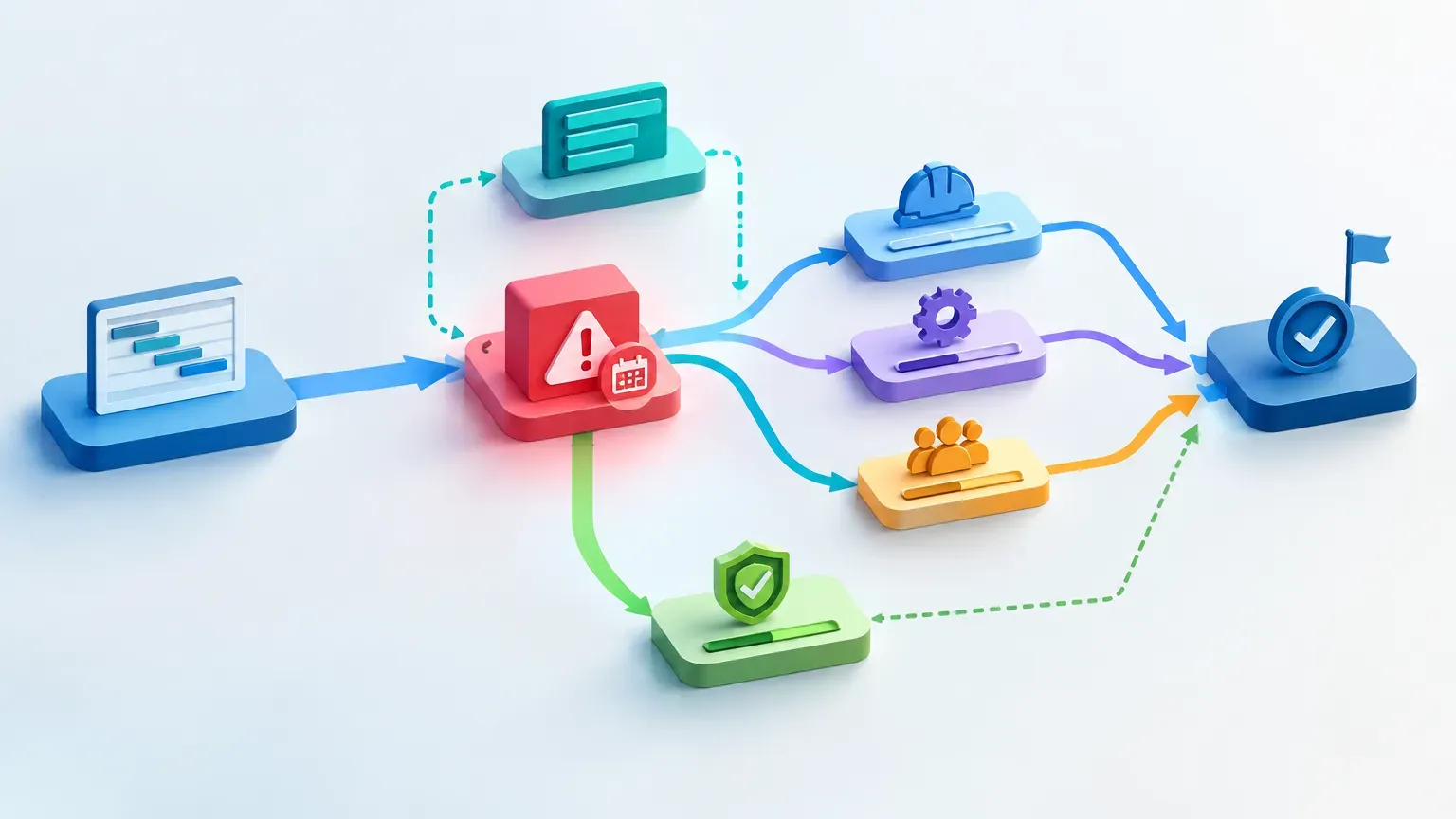
The short answer
A delay event does not automatically mean the project has suffered critical delay.
The key question is when the event began affecting the path to completion.
Float may absorb part of the delay. Another activity may already be controlling the finish. Alternative sequence may reduce the consequence.
Credible delay analysis therefore needs cause, timing, logic and actual project conditions — not simply the existence of a late event.
Events are easy to record. Consequence is harder.
Construction teams are good at noticing events.
A drawing was late.
Access was restricted.
A delivery slipped.
An instruction changed the work.
The event can usually be dated.
The harder question is what happened next.
Which activity was affected?
Was that activity critical?
How much float existed?
Could the project work elsewhere?
When did the event begin to change the completion forecast?
That chain is where delay analysis becomes meaningful.
The wider programme-confidence view depends on exactly this difference between event and consequence.
The start of an event and the start of critical delay may be different dates
Suppose an approval is ten days late.
The affected activity had five days of float.
The first five days consumed flexibility.
Only after that did completion risk begin to emerge.
The event began on day one.
The critical effect may have begun later.
This distinction matters because it creates a more accurate project story.
It also prevents every late event from being treated as though it immediately moved completion.
Programme logic helps explain the transition.
Concurrent problems complicate the story
Projects rarely suffer one clean delay at a time.
A client instruction may affect one area while a subcontractor is already late elsewhere.
Procurement may be delayed while another critical path is controlling completion.
This makes causation harder.
Management should resist overly simple narratives.
The project may have several problems, but not all have equal effect on the finish at the same time.
Good contemporaneous programme updates help separate these periods.
Which path was critical during the event?
What other delays existed?
What changed later?
This is much harder to reconstruct months afterwards.
Mitigation changes consequence without erasing the event
A delay event can occur and the project can mitigate it.
Work is resequenced.
Another area is advanced.
Additional resource is used.
A temporary solution is introduced.
The original event remains part of project history.
The final effect may be smaller because the project responded well.
This is important both operationally and commercially.
The project should record what mitigation occurred and what it cost.
Otherwise the programme may appear to show “no delay” even though substantial effort was required to protect the finish.
The programme should show the logic of impact, not just a narrative
Written explanations are useful.
The schedule should support them.
If the project says one event delayed completion, the programme logic should show how the affected activity connects to the completion path.
If the event had float, the analysis should recognise it.
If recovery changed the sequence, the programme should show that too.
This is what gives programme evidence credibility.
The narrative and the schedule should tell the same story.
Delay analysis is strongest when the update process is disciplined
A reliable sequence of programme updates creates a timeline of how the project evolved.
Actual dates.
Remaining durations.
Logic.
Critical path.
Float.
Forecast completion.
When those updates are consistent, later delay analysis has a strong foundation.
When updates are irregular or heavily rewritten after the fact, causation becomes more difficult to prove.
This is why good programme control and good delay evidence are the same discipline at different moments.
The first manages the project.
The second explains what happened.
Early clarity improves management even if no claim is ever made
Delay analysis is sometimes treated as a claims activity.
That misses its operational value.
If management understands which event is genuinely controlling completion, it can target intervention.
Escalate the right approval.
Accelerate the right package.
Protect the right workfront.
Avoid spending recovery money on activities that do not move the finish.
The delay story helps management before it helps lawyers or commercial teams.
That is why it should be developed while the project is still live.
There is also a practical reporting benefit when the project separates event date, impact date and recovery date.
One event can be recognised immediately, begin affecting critical work later and be partially recovered later still.
Those dates describe different things.
Keeping them separate helps the team explain the project more clearly and prevents a single broad “delay period” from hiding how the programme actually evolved.
That clarity is useful to management even before any contractual analysis begins.
The distinction between event and impact also protects the project from overclaiming and underreacting at the same time.
If every late event is immediately labelled critical, the programme loses credibility.
If no event is treated seriously until completion visibly moves, management reacts too late.
The project needs an intermediate discipline: test the event against the live schedule while there is still time to respond.
How much float exists?
Which downstream activity depends on it?
What mitigation is realistic?
Is another path already controlling the finish?
These questions can be answered provisionally and then updated as the event develops.
That creates a more honest delay record.
The project does not need to know the final entitlement on day one.
It needs to preserve the evolving operational consequence.
This is especially useful when mitigation succeeds.
Suppose the project loses access to one area but advances another.
The original event is real.
The immediate completion effect may be reduced.
Later, the resequencing may create congestion or consume float elsewhere.
The full consequence unfolds over time.
A simple “delay/no delay” label cannot capture that.
A sequence of contemporaneous programme updates can.
That is why delay analysis is strongest when it grows with the project.
The final conclusion is built from a series of credible observations rather than one retrospective interpretation.
This also helps the project avoid false precision.
Delay analysis often becomes weaker when teams try to declare a final number too early.
The effect may still be developing.
Float may continue to move.
Mitigation may succeed or fail.
A better approach is to update the impact view as evidence changes while preserving the earlier position.
That creates an honest sequence of understanding rather than one artificially fixed conclusion.
Later analysis can then explain how and why the assessed impact changed over time.
The project should also be careful with retrospective logic changes.
Sometimes a later schedule update changes relationships between activities for legitimate planning reasons.
That can make earlier delay periods look different if the history is not preserved.
The safest approach is to retain the contemporaneous logic and explain later changes separately.
That protects the integrity of the delay story and avoids judging past events through a network that did not exist at the time.
That preserved history also helps management compare the delay assessment with what the team actually believed at the time. If the conclusion changes later, the reason for the change can be explained rather than hidden.
That also helps separate genuine completion risk from temporary disruption that the live programme can absorb without changing the forecast.
It gives management a cleaner basis for deciding whether intervention is still needed.
Where Epicor Saturn fits in delay-impact control
Epicor provides the enterprise-grade ERP foundation for approvals, purchasing, finance and governance. Epicor Saturn adds the construction and engineering project layer that connects programme events with workfronts, procurement, resources and project cost.
That relationship helps the project connect the timing story with the operational and commercial consequences behind it.
For delay-impact control, Epicor Saturn links programme events to the workfronts, resources and costs they affect, on top of Epicor's enterprise-grade ERP foundation. Explore Epicor Saturn for construction and engineering.
Frequently asked questions
Does every late event cause project delay?
No. Float, alternative sequence or another critical path may absorb or overshadow the event.
Why can critical delay begin later than the event itself?
Because available float may absorb part of the initial slippage.
What is mitigation?
Action taken to reduce the effect of a delay, such as resequencing or additional resource.
Why are regular programme updates important for delay analysis?
They preserve contemporaneous evidence of actual progress, logic, float and criticality.