

Can You Trace This Order Before the Buyer Calls?
Traceability becomes operational when a team can move from shipment to order, factory, material lot and decision history quickly—before a buyer escalates.
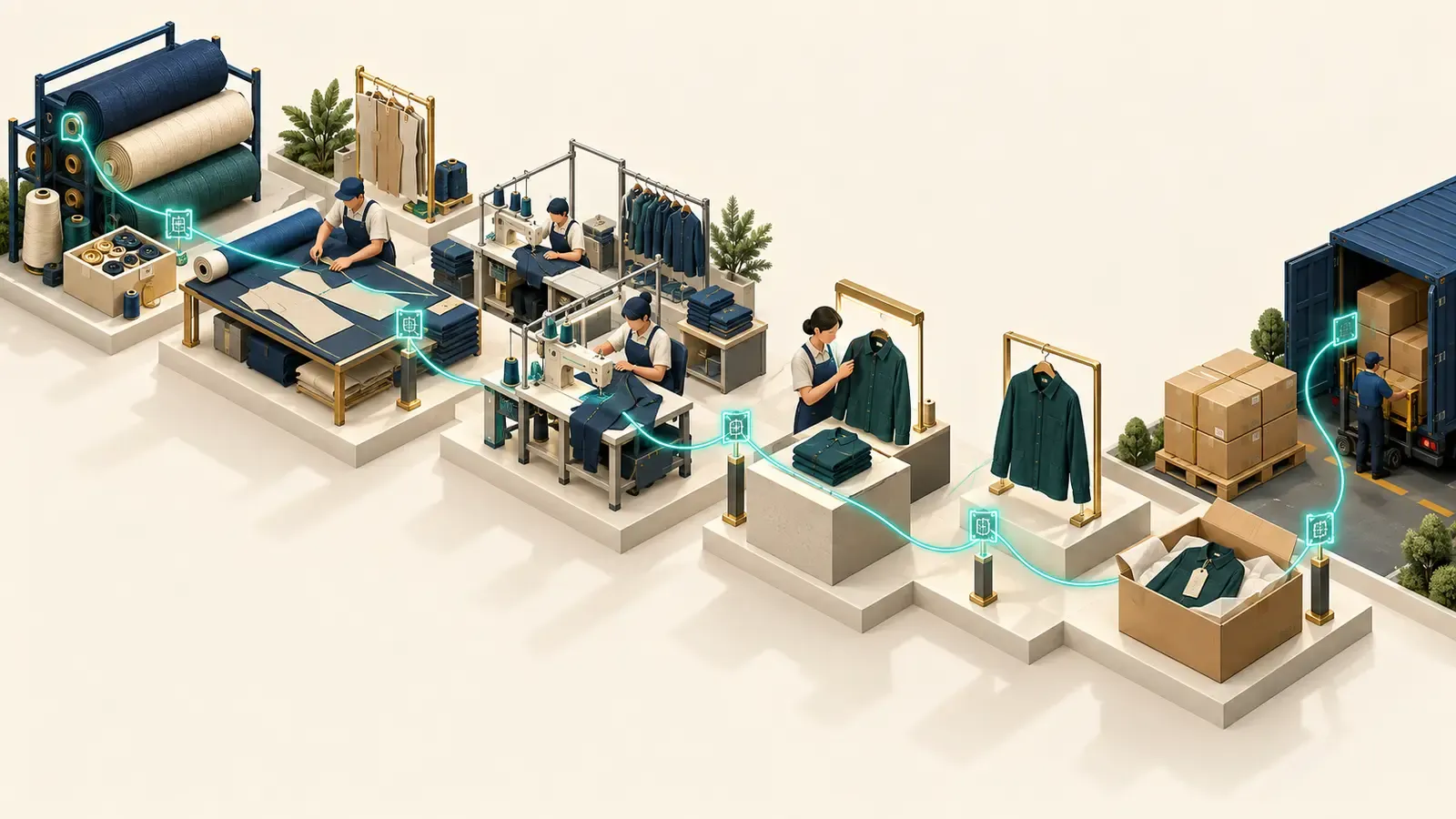
The buyer’s question is short: “Which fabric lot went into these cartons?”
The answer triggers a long chain of calls. The warehouse checks receipts. Cutting searches tickets. Production looks for bundle records. Quality opens inspection files. Shipping identifies which cartons left on which date. The evidence exists, but the path between it does not.
The short answer
Garment order traceability means being able to connect a finished shipment back through factory, production order, cut work, material lots and supplier records—and to move forward from an affected material or event to the orders and shipments concerned. It works when trace links are captured during normal operations, not assembled only after a buyer request.
Traceability is a retrieval test
Many organisations possess records without being able to retrieve a reliable answer. A spreadsheet lists fabric receipts; a quality system stores inspections; cartons have labels. Traceability asks whether these objects share identifiers and whether handoffs preserve them.
A practical test uses two directions:
- Trace back: From carton or garment, identify order, factory, production batch and relevant material lot.
- Trace forward: From a supplier lot, quality event or production exception, identify affected work and shipments.
If either direction requires memory, the chain is incomplete.
The evidence chain
For an apparel order, useful links can include supplier and purchase order, received lot, inspection or approval, allocation, cut order, bundle or production batch, quality record, packing list, carton and shipment. Not every product requires the same granularity. The business should choose the level based on risk, buyer commitments and the decisions it must support.
The OECD notes the complexity and fragmentation of garment and footwear supply chains and provides due-diligence guidance for identifying and addressing adverse impacts. See the OECD garment and footwear supply-chain resource. Operational traceability does not by itself prove responsible performance, but it makes investigation and action more practicable.
Capture the link where work happens
Retrospective traceability is expensive because teams must infer relationships. The more reliable approach captures a link at the event: material is received against a purchase order; an approved lot is allocated; a cut order consumes identified material; production and quality events relate to the order; packing relates accepted goods to cartons and shipment.
ACC describes order tracking, material planning, production visibility and multi-factory functions in Venus. Their traceability value comes from continuity across those records.
The before-the-buyer drill
Select one recently shipped order and set a reasonable time limit. Ask a cross-functional team to answer:
1. Which factory and production order made it?
2. Which fabric and critical trim lots were used?
3. What relevant inspections and quality holds occurred?
4. Which cartons and shipment contained the goods?
5. If a lot were affected, what else would require review?
Record where the trail breaks, where names conflict and where one person’s memory repairs the chain. Those are design priorities.
Do not turn traceability into data hoarding
More fields do not guarantee a better answer. Capture identifiers with a defined purpose, owner and retention rule. Protect commercially sensitive and personal information. Make corrections auditable. The goal is proportionate evidence that supports operations, quality response and due diligence—not an indiscriminate archive.
This is the final cluster in Inside the Invisible Factory, which follows the hidden handoffs where garment orders lose control.
Traceability during a real exception
Imagine inspection identifies a material concern after part of the order has shipped. The immediate task is not to produce every record. It is to define the affected population accurately: which lot, which allocation, which cut work, which production batches and which cartons.
Too little linkage broadens the response unnecessarily; everything becomes suspect. False precision is equally dangerous if links were inferred rather than captured. A good trace record shows both the relationship and the confidence or status of the underlying event.
Governance that keeps the chain usable
Traceability weakens when identifiers are reused, free text substitutes for controlled references or corrections erase history. Governance should specify who creates key records, when an identifier becomes final, how exceptions are corrected and how long evidence is retained.
Periodic drills are more revealing than policy review alone. Select a shipment, trace it backward and forward, time the exercise and validate a sample of the physical evidence. Feed each break back into process design. The result is not only faster response; it is greater confidence that routine operational records describe what actually happened.
Decide the right unit of trace
Traceability granularity should follow the question the business needs to answer. A fabric lot may be relevant across several cut orders. A production bundle may preserve colour, size and operation identity. A carton may connect accepted finished goods to a shipment. Item-level identity may be appropriate in some contexts but unnecessary in others.
Choose too broad a unit and an exception affects more goods than necessary. Choose an extremely fine unit without an operational reason and capture becomes costly, fragile and difficult to sustain. Document the rationale and review it when products, buyer requirements or risks change.
Traceability and due diligence
Due diligence is broader than tracing products. It includes identifying and assessing risks, acting to prevent or mitigate harm, tracking results and communicating appropriately. Traceability supports those activities by making relationships and evidence retrievable, but a database cannot replace judgement or engagement.
This distinction prevents overclaiming. A connected system can help a company find supplier, material, order and production records. Whether those records satisfy a particular legal, buyer or voluntary requirement depends on the relevant standard and the quality of the underlying process.
Questions for technology selection
Ask whether the solution preserves identifiers across purchasing, inventory, allocation, production, quality, packing and shipment. Test corrections and split or combined lots, not only the happy path. Check whether users can trace forward and backward without technical assistance. Confirm access control, retention and export needs.
Most importantly, run the before-the-buyer drill with realistic data. A convincing demonstration is useful; a repeatable answer from daily operations is the goal.
Make retrieval a weekly operating skill
Traceability fails where ordinary operations fail: incomplete identifiers, late capture and silent corrections. Treat retrieval as a normal operating skill, not a side compliance project.
Each week, pick one finished shipment and ask for the chain without warning: supplier lot, allocation, cut batch, production identity, quality record and carton to order. Time the answer and mark every reconstructed link. Those breaks are design defects. OECD due diligence guidance for garment and footwear supply chains emphasises identifying risks and tracking responses; retrieval must work when an exception appears.
Close each drill with one capture change—a mandatory field, a correction path that preserves history, or ownership for a reused identifier.
Frequently asked questions
What is garment traceability?
It is the ability to follow relevant materials, production and shipment relationships through the lifecycle of a garment order.
Is traceability the same as compliance?
No. Traceability provides evidence and retrieval paths. Compliance or due diligence also requires policies, assessment, action, monitoring and communication appropriate to the obligation.
Must every individual garment have a serial number?
Not always. The required level may be lot, batch, bundle, carton or item, depending on product risk, process and buyer need.
The strongest moment to build the answer is not when the buyer calls. It is when the material, order and product first meet.
Sources and further reading
- ACC: Venus ERP for apparel and garment manufacturing
- OECD: Responsible garment and footwear supply chains
Decide the right unit of trace
Traceability granularity should follow the question the business must answer. A fabric lot may span several cut orders. A production bundle may preserve colour, size and operation identity. A carton may connect accepted goods to a shipment. Item-level identity may be appropriate in some contexts but unnecessary in others.
Choose too broad a unit and an exception affects more goods than necessary. Choose an extremely fine unit without an operational reason and capture becomes costly and fragile. Document the rationale and review it when products, buyer requirements or risks change.
Traceability and due diligence
Due diligence is broader than tracing products. It includes identifying and assessing risks, acting to prevent or mitigate harm, tracking results and communicating appropriately. Traceability supports those activities by making relationships and evidence retrievable, but a database cannot replace judgement or engagement.
This distinction prevents overclaiming. A connected system can help find supplier, material, order and production records. Whether they satisfy a legal, buyer or voluntary requirement depends on the relevant standard and the quality of the process.
When selecting technology, test corrections and split or combined lots, not only the happy path. Ask whether identifiers survive purchasing, inventory, allocation, production, quality, packing and shipment. Check whether users can trace forward and backward without technical help. Confirm access control, retention and export needs. Most importantly, run the before-the-buyer drill with realistic data. A convincing demonstration is useful; a repeatable answer from daily operations is the goal.
That repeatability turns traceability from an emergency response into an everyday management capability.
It also lets the company answer a buyer with evidence, proportion and confidence instead of a hurried collection of disconnected files.