

A Defect Was Found on the Line. Should Production Stop, Rework or Continue?
A shop-floor defect becomes expensive when disposition is unclear. EMS nonconformance control should connect the affected material or unit, quantity, defect, revision, work order, containment and MRB decision before production continues.
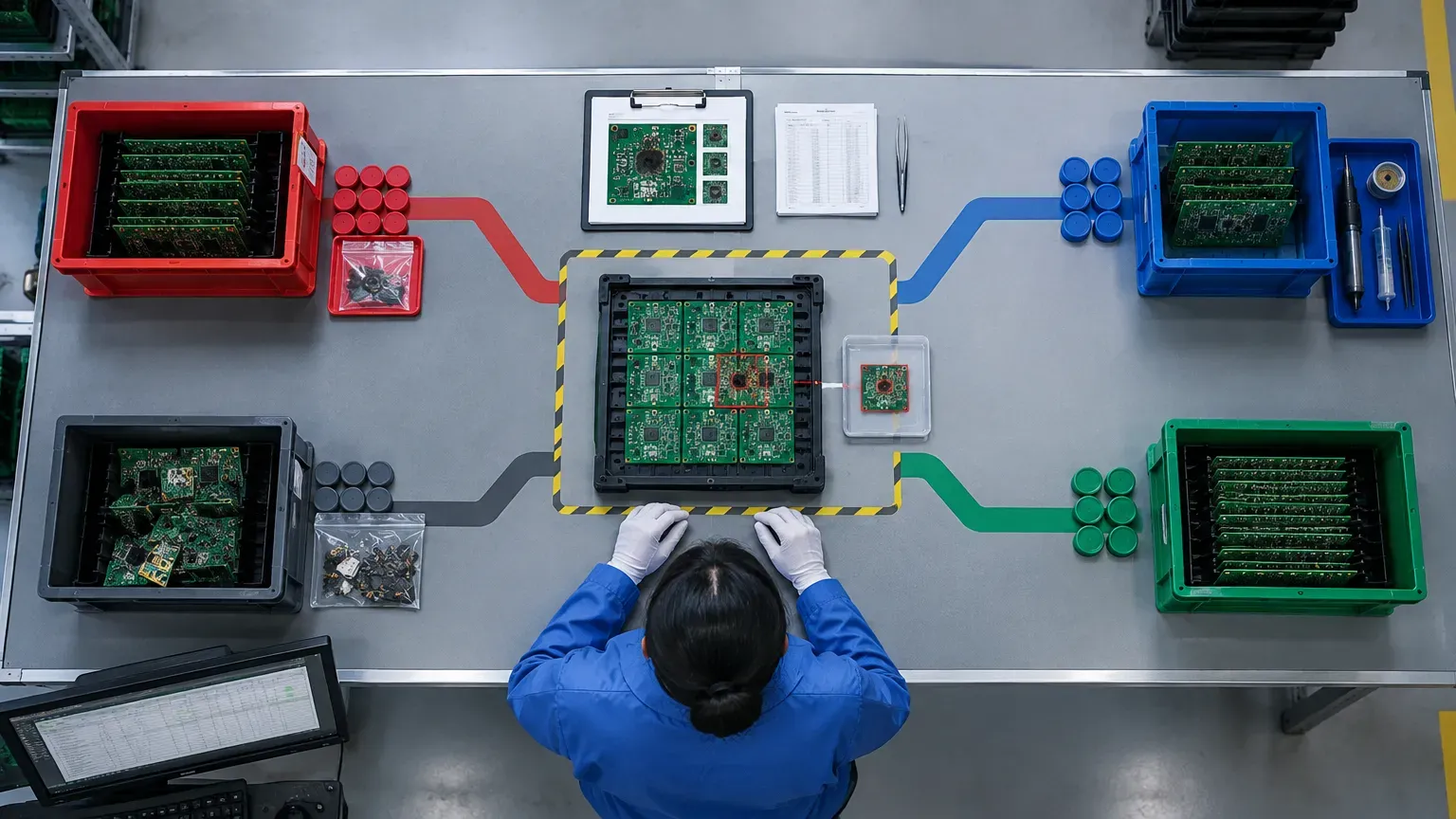
The short answer
A shop-floor nonconformance should immediately identify the affected unit or material, quantity, work order, revision, defect and containment status. Production can then make a controlled disposition—stop, segregate, rework, use under deviation, scrap or continue unaffected work—rather than relying on verbal instructions.
The same question belongs to the wider A Defect Reached the Customer. Can Your EMS Operation Contain It Fast Enough? operating picture: nonconformance and MRB control has to remain connected to the decisions made before and after it, rather than becoming a separate local control.
Contain before diagnosing everything
The first action is often to prevent more affected product from moving. Root cause can take longer. Separate immediate containment from the later analysis. Identify the affected population. Start with the smallest known unit: serial, lot, panel, reel or work order. Then expand only as evidence requires. Use quality hold as a real state. Material or WIP on hold should be operationally blocked, not simply marked in a quality note while remaining available to production. Define disposition choices clearly. Common dispositions include rework, repair, use-as-is under deviation, return to supplier and scrap. Each should have appropriate authority. Keep deviation temporary. A use-as-is decision for one lot or work order should not silently become a new standard. Capture scope and expiry.
Link MRB to the exact revision. A defect may be acceptable for one revision and unacceptable for another. Product and engineering context matter.
Protect unaffected quantity
A defect on one serial does not always justify holding the entire work order. Use traceability and defect evidence to narrow the hold. Preserve quantity integrity. Track how much is held, released, reworked and scrapped. Otherwise the final work-order and inventory balance becomes difficult to reconcile. Connect rework to genealogy. If a component is replaced during disposition, update the as-built record where required. The final unit history should remain true. Retest after rework. A repaired unit should return through the appropriate validation path. The required test depends on the failure and product risk. Avoid uncontrolled bypass. Operators under delivery pressure may be tempted to continue production around a known issue. Require explicit authority for any exception.
Use repeat MRB as a warning. If the same defect repeatedly appears in MRB, the organization may be treating symptoms rather than correcting the process.
Measure decision lead time
WIP can sit idle waiting for disposition. Track how long important holds remain unresolved. Connect MRB to schedule risk. A quality hold affects customer delivery. Planning and customer service should see the impact rather than discover it at shipment. Capture cost of disposition. Scrap, rework and inspection create economic consequences. Connect them to the defect and job. Close the issue when the physical state agrees. Do not close the nonconformance while held material is still unidentified, rework is incomplete or inventory status remains wrong. Use temporary containment instructions. When a defect is active, define how operators handle affected WIP until MRB decides the long-term disposition. Temporary inspection, segregation or limited continuation should be explicit and revision-controlled.
Link nonconformance to customer requirement. Some defects can be accepted internally but violate a customer-specific criterion. The MRB decision needs the correct customer/product context.
Escalate systemic defects
A single wrong component on one unit may be local. The same error across several work orders can indicate process-control failure. Scale the response when recurrence changes the risk. Use nonconformance data in training. Repeated operator confusion may indicate weak instruction or training. Feed the evidence into standard work rather than treating each unit as an isolated mistake. Separate unit disposition from process disposition. MRB usually decides what to do with the affected unit or material. Management should also ask what happens to the process that created it. A unit can be reworked successfully while the line continues producing the same defect. For significant nonconformance, pair the physical disposition with a process decision: continue under containment, stop the operation, change a parameter, add temporary inspection, or wait for engineering review. This prevents MRB from becoming a repair desk that clears units without addressing the manufacturing condition behind them.
Define escalation by defect severity and recurrence. A single minor cosmetic defect may not justify stopping an entire line. A wrong component, polarity error, safety-related condition or repeated electrical failure may require immediate escalation. Create severity and recurrence rules that help supervisors know when local disposition is enough and when quality, engineering or management must become involved. The rule should be simple enough for real-time use. Consistency matters because the same defect should not be treated as routine on one shift and critical on another. Protect evidence before rework. Once a unit is repaired, important evidence can disappear. A technician may replace a component, clean solder residue or overwrite firmware before engineering has understood the original failure. For high-impact nonconformance, define when the unit should be held for analysis before repair begins. Photographs, AOI images, tester logs, removed components and lot identity can all support root cause. This is particularly important during NPI or when a customer escape resembles the shop-floor defect.
Use disposition history to challenge standards. If the same part, operation or specification repeatedly receives use-as-is approval, the organization may have a mismatch between the documented standard and what is actually acceptable. Review recurring MRB dispositions. The right answer may be process improvement, specification clarification, supplier correction or formal engineering change. Repeated deviation should not quietly become the real process while the official baseline remains unchanged.
Connect hold quantity to customer delivery risk
A quality hold can affect one serial or an entire work order. Planning needs the exact quantity unavailable and the expected decision timing. If only ten units are held, the remaining order may still ship. If the whole lot is blocked, the customer date may be at risk immediately. Linking quality hold quantity with order commitment allows commercial teams to communicate earlier and prevents the surprise of discovering a blocked shipment only at final release. Use quarantine locations that match system status. Physical segregation supports the digital hold. If rejected or pending material remains mixed with normal stock, an operator can consume it despite the system status. Use quarantine locations, controlled labels or line-side segregation that make the physical state obvious. The design should fit the factory rather than create unnecessary movement, but the principle is simple: a held unit should be difficult to mistake for released production.
Review MRB authority by value and risk. Not every disposition needs the same approval level. Minor rework within an approved instruction may be handled quickly, while use-as-is on a critical customer feature may require engineering or customer authorization. Define thresholds so low-risk decisions move fast and high-consequence decisions receive appropriate governance. This prevents both bottlenecks and uncontrolled exceptions. Close quantity reconciliation after disposition. When MRB releases, reworks or scraps material, update inventory and work-order quantity promptly. A physical decision without a matching transaction creates later reconciliation problems. Quantity integrity also matters for traceability because investigators need to know which units were actually affected and how they were ultimately handled.
Use first-piece containment after a process correction. After changing a parameter, fixture, instruction or material condition, verify the first affected units deliberately before releasing normal flow. This short confirmation step can prevent a weak correction from spreading through the next batch and gives quality objective evidence that the MRB decision is working under real production conditions.
This keeps the disposition connected to real execution evidence.
What management should measure
Track open nonconformances, WIP on hold, MRB decision time, rework quantity, scrap quantity, units released under deviation, repeat defect by cause, nonconformance age and customer-date impact caused by quality hold.
A practical review
Choose the five oldest quality holds. For each one, confirm affected quantity, physical location, product revision, owner, disposition and next action. Any record that does not match the physical WIP is a control gap.
Where Epicor Mars fits in nonconformance and MRB control
For nonconformance and MRB control, the key system-design question is how to keep enterprise control and electronics-specific execution on the same operating thread. Epicor provides the enterprise-grade ERP foundation for customer orders, purchasing, inventory, planning, costing, finance, approvals and governance. Epicor Mars extends that foundation with the EMS industry context needed at the point of work, including material identity and readiness.
That connection is directly relevant to A Defect Was Found on the Line. Should Production Stop, Rework or Continue?. A shop-floor defect becomes expensive when disposition is unclear. EMS nonconformance control should connect the affected material or unit, quantity, defect, revision, work order, containment and MRB decision before production continues. When the Epicor Mars execution record stays tied to the Epicor work order, material and customer context, management can compare the business commitment with what the factory actually executed without maintaining a second source of truth.
For nonconformance and MRB control, that complementary positioning is the point: Epicor remains the enterprise-grade foundation, while Epicor Mars adds the EMS workflows needed to make this particular control operational on the factory floor. Explore Epicor Mars for electronics manufacturing.
Frequently asked questions
Should production always stop after a defect?
No. The decision depends on scope and risk, but affected product should be controlled immediately.
Is MRB only for material defects?
No. It can address product, process or supplier nonconformance where a formal disposition is needed.
Can use-as-is be permanent?
Not automatically. Permanent acceptance should be reflected in the controlled product/process baseline.
Why track MRB decision time?
Because unresolved quality holds consume WIP, capacity and customer lead time.