

The PCB Is Ready. Are Programming and Test Ready Too?
Electronics production can be blocked even when material and assembly are ready if firmware, programming files, test fixtures, limits, scripts or revision control are incomplete. NPI should treat test readiness as part of production readiness.
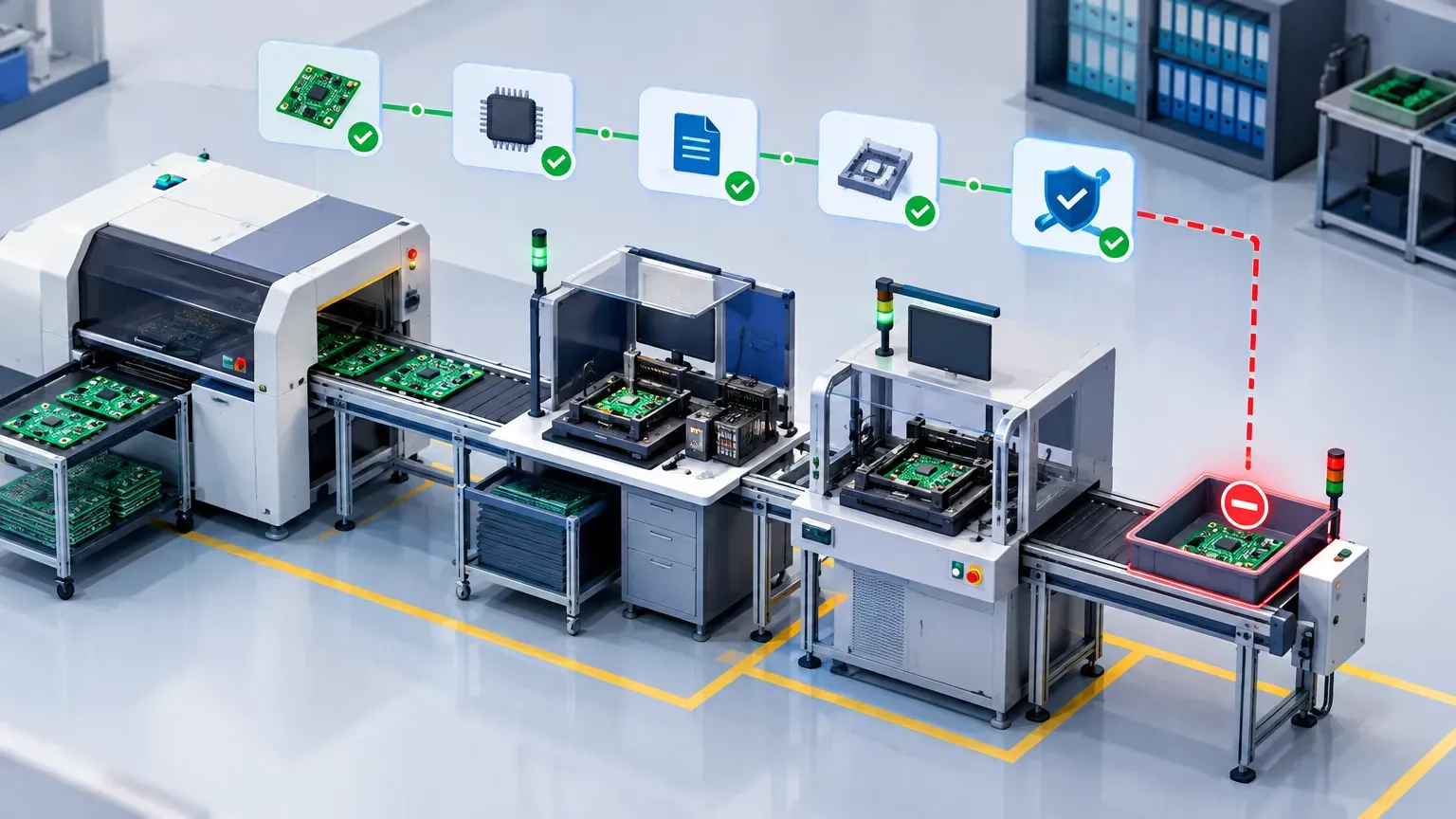
The short answer
An electronics work order is not ready just because the PCB, components and assembly route are available. Firmware, programming files, test fixtures, test scripts, limits and revision approvals can all block or invalidate production.
NPI should treat digital and test assets as controlled production inputs.
The same question belongs to the wider Prototype Built. How Do You Turn NPI Into Stable EMS Production? operating picture: programming and test readiness has to remain connected to the decisions made before and after it, rather than becoming a separate local control.
Firmware is a revision-controlled material
The hardware revision and firmware revision together can define the finished product.
Record which combination is valid.
Do not rely on a shared folder containing several binaries with similar names. Control programming files. Programming stations need the correct file and settings.
The process should identify which revision applies to the work order.
If the file changes, effectivity should be controlled like any other engineering change. Make fixtures identifiable. A test fixture can become obsolete after product revision.
Give fixtures an identity and status.
Operators should be able to verify that the correct fixture is used. Control test limits. Changing a test limit can turn failures into passes or passes into failures.
Treat limit revisions as quality-controlled configuration.
The history should show which limits applied to which build.
Separate engineering debug from production test. NPI engineers may use flexible tools during debug.
Volume production needs a defined test process.
Before handover, decide what becomes the standard production test and what remains engineering-only. Verify fixture capacity. A test method can be technically ready but unable to support the intended volume.
Check cycle time, number of fixtures and maintenance needs before volume release.
Plan calibration and maintenance
Where test equipment or fixtures require calibration or verification, include those controls in the production baseline.
A test result is only as trustworthy as the controlled test environment. Connect failure data to the work order. Test failures should retain product, operation and unit context.
This allows NPI teams to analyze defect patterns rather than count failures without cause. Manage programming rework. A unit may be reprogrammed.
If firmware identity matters to the customer, the final as-built record should reflect the current programmed version. Protect customer-specific data. Some products require serial data, keys or customer files.
Define security and access rules.
Do not let convenience at the test station bypass enterprise control.
Use pilot to validate test workflow. During pilot, measure:
- test time;
- false failures;
- retest rate;
- fixture problems;
- unclear limits;
- operator intervention.
A test process that needs the test engineer beside every unit is not volume-ready. Control software-hardware compatibility. One firmware version may require a particular PCB or component revision.
Represent valid combinations.
A work order should not pair hardware and software versions accidentally simply because each is individually released.
Make golden samples identifiable
Golden boards or reference units can support test and inspection.
Give them controlled identity, revision and status.
An outdated reference can teach operators to accept the wrong behavior. Plan data retention. Test results can be large.
Define which results need long-term retention and which summary needs to be visible in the manufacturing record.
The design should support customer and quality needs without collecting unusable data indefinitely. Treat test assets as production master data. Programming files, test scripts and limit sets are often managed like engineering files.
For production they behave more like controlled master data.
They need identity, revision, approval, effectivity and ownership.
That does not mean they must all be stored directly inside ERP.
It means the manufacturing record must know which controlled version is valid for the work order.
Define the relationship between hardware and software revision. Electronics products can have compatible and incompatible combinations.
Create a clear rule for which firmware or program revision belongs to each hardware revision.
If several combinations are allowed, document them.
This prevents production from assuming the newest file is automatically correct for every board. Protect test changes after pilot. Changing a test limit after pilot can materially alter yield and acceptance.
Require the right approval for production test changes.
If the limit change reflects a true product-specification update, connect it to engineering change.
If it is a tester correction, preserve the reasoning.
The history matters when yield moves unexpectedly.
Make test-failure codes useful. A generic FAIL result has limited improvement value.
Use failure categories that help distinguish product defect, fixture problem, programming issue, communication error or other condition.
This supports faster NPI learning and reduces unnecessary rework.
Separate retest from rework
A unit that fails and then passes without repair may indicate test instability.
A unit that passes after component replacement is a repair case.
Track them separately.
Combining both into one “retest pass” category can hide fixture and limit problems. Plan fixture spares and scaling. A pilot may run with one fixture.
Volume may require several.
Before handover, confirm fixture duplication, maintenance, calibration and replacement strategy.
A production line is not volume-ready if output depends on one fragile development fixture. Connect serial generation to enterprise control. If the product uses serial numbers, define where they come from, when they are assigned and how duplicates are prevented.
Epicor Mars execution can support the shop-floor capture while Epicor provides enterprise order/product context.
The serial should remain linked to the actual work order and configuration.
Review test data for management usefulness. Collecting every measurement can create a large database with little operational value.
Identify which results support customer evidence, genealogy, quality learning and process improvement.
Keep the production summary connected to the work order even when detailed measurements remain in specialist test systems. Make operator recovery clear. If programming or test fails because of station communication or device error, define what the operator should do.
Unclear recovery encourages repeated attempts, unofficial overrides or unnecessary repair.
A controlled recovery path makes digital production more reliable. Control tester software dependencies. A test script may rely on operating-system versions, drivers, libraries or external databases.
Volume readiness should include the supportability of those dependencies.
A test station that works only on one engineer's laptop is not a production system.
Plan tester recovery and backup
If a test PC or fixture fails, the line should know how to recover.
Back up approved configurations and define replacement/reload procedures.
This is operational resilience, not just IT convenience. Use serial-to-test-result linkage where required. For products requiring unit-level quality evidence, connect the finished serial to the relevant test result.
The detailed data can remain in a specialist system, but the manufacturing record should be able to prove that the correct test was completed. Manage test overrides explicitly. Sometimes engineering authorizes a temporary limit or bypass during NPI.
Record who approved it, which units it affects and when it expires.
Do not allow temporary debug overrides to become the invisible production standard.
Review test capacity versus takt. A test process can pass every unit and still be the volume bottleneck.
Compare test cycle with intended production rate.
If capacity is insufficient, add fixtures, parallel stations or process improvement before volume release. Include operator permissions. Programming and test stations can change product configuration, so access matters.
Define who may select, load or override controlled files and limits.
The operator interface should make the correct released option easiest to use and exceptional authority visible.
This also improves auditability when customers ask which controlled program and test configuration was used for a specific build.
What management should measure
Useful indicators include:
- jobs waiting for firmware;
- fixture readiness;
- test-limit changes after pilot;
- retest rate;
- false failure investigation;
- programming errors;
- units with unclear firmware history.
A practical review
Pick one product entering pilot. Ask whether an operator can identify the correct firmware, fixture, script and limits from the controlled work order without asking the NPI engineer.
Where Epicor Mars fits in programming and test readiness
For programming and test readiness, the key system-design question is how to keep enterprise control and electronics-specific execution on the same operating thread. Epicor provides the enterprise-grade ERP foundation for customer orders, purchasing, inventory, planning, costing, finance, approvals and governance. Epicor Mars extends that foundation with the EMS industry context needed at the point of work, including material identity and readiness.
That connection is directly relevant to The PCB Is Ready. Are Programming and Test Ready Too?. Electronics production can be blocked even when material and assembly are ready if firmware, programming files, test fixtures, limits, scripts or revision control are incomplete. NPI should treat test readiness as part of production readiness. When the Epicor Mars execution record stays tied to the Epicor work order, material and customer context, management can compare the business commitment with what the factory actually executed without maintaining a second source of truth.
For programming and test readiness, that complementary positioning is the point: Epicor remains the enterprise-grade foundation, while Epicor Mars adds the EMS workflows needed to make this particular control operational on the factory floor. Explore Epicor Mars for electronics manufacturing.
Frequently asked questions
Is firmware really part of manufacturing configuration?
For programmed electronics, yes. It can be as important as the hardware revision.
Should test limits be revision-controlled?
Where they affect product acceptance, yes.
Can test data remain in a specialist tester?
It can, but the product/work-order relationship and required result should remain connected to the manufacturing record.
What makes test volume-ready?
Stable files, fixtures, limits, cycle time and an operator workflow that does not depend on continuous engineering intervention.