

The Customer Returned One Unit. How Many More Could Be Affected?
An EMS RMA investigation is faster when the returned serial can be traced backward to components, lots, process and test—and forward from suspect material or process conditions to other units and shipments.
The short answer
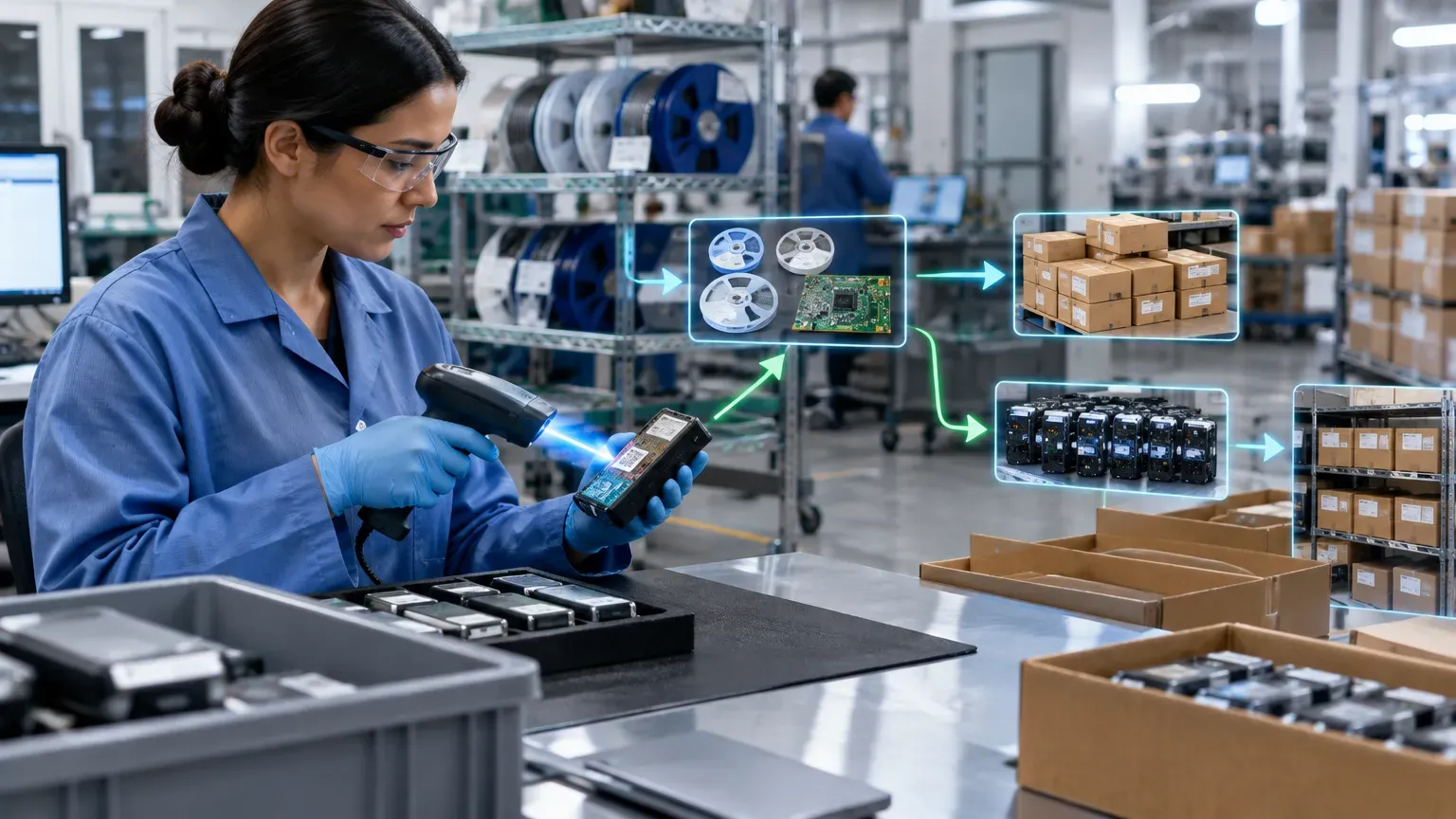
An EMS RMA investigation should move in two directions. Backward trace reconstructs what went into the returned unit and what happened during production. Forward trace starts from a suspect component lot, process condition or revision and identifies every other unit and shipment that may share the same exposure.
The same question belongs to the wider A Defect Reached the Customer. Can Your EMS Operation Contain It Fast Enough? operating picture: RMA and forward/backward trace has to remain connected to the decisions made before and after it, rather than becoming a separate local control.
Anchor the return to a controlled identity
Use finished serial, lot, shipment or another reliable identifier. The investigation is weak if the returned unit cannot be matched to production history. Verify product revision. A customer may return an older revision while the factory currently builds a new one. Do not investigate against the latest BOM automatically. Trace critical components backward. Identify actual consumed manufacturers, lots or serials where the traceability model requires them. Trace process history. Review route, significant operation status, rework, repair and test history. Planned routing alone is not enough. Trace firmware and programming. For programmed electronics, hardware and software revision may both matter. Review prior repair. A unit may have been repaired before shipment or during service. Final genealogy should reflect the delivered configuration.
Compare returned failure with production test
Did the unit pass the same function at final test? If so, consider intermittent, environmental or field conditions as well as test escape. Define the suspect common factor. The investigation may point to one component lot, supplier, machine, fixture, program revision or time window. Run forward trace. Find all other units that share the suspect factor, including WIP, finished stock and shipments. Narrow the affected population. Do not automatically hold every unit of the product if evidence supports a smaller population. Preserve shipment relationship. Know which customers and deliveries contain the affected units. This makes containment communication practical. Coordinate service and factory data. RMA findings should feed production, quality and engineering rather than remain isolated in service.
Track no-fault-found returns
Repeated no-fault-found can indicate intermittent defects, test mismatch, customer-use issues or poor problem description. Update genealogy after repair. If the returned unit is repaired, record replacement components and retest so its new configuration remains traceable. Use RMA recurrence as design evidence. Repeated returns of the same failure can justify design or process change even when factory yield appears healthy. Close the customer loop. Record disposition, replacement/repair, customer communication and corrective action where applicable. Preserve failure description from the customer. The quality of the investigation depends on the original symptom. Capture customer environment, timing and behavior before the returned unit is repaired or reset. Avoid destroying evidence too early. A well-meaning repair technician can remove the component that would have shown the root cause. Define when analysis should precede repair for significant returns.
Use shipment data to sequence containment
If affected units went to several customers or regions, prioritize communication and hold action based on exposure and risk. Compare field and factory failure mode. A product can pass factory test and fail under temperature, vibration or real load. RMA analysis should consider the conditions the production test does not reproduce. Create a consistent RMA intake record. Customer-return analysis improves when the original symptom is captured consistently. Record when the failure occurred, operating condition, frequency, environment, customer observation and any field troubleshooting already performed. A vague description such as 'not working' forces the factory to rediscover context. Good intake information helps test engineering reproduce the failure and reduces the chance that a no-fault-found result simply reflects incomplete information.
Preserve customer evidence before reset or repair. Returned electronics may contain logs, configuration, firmware state or physical evidence that disappears when the unit is reset or repaired. Define when engineering must capture that evidence first. This is particularly important for intermittent failures. A fast repair can satisfy the immediate service need while destroying the strongest clue to systemic root cause. Quality and service teams should agree on the priority for high-risk or recurring returns. Use common-factor analysis across several returns. One RMA can be random. Several RMAs can reveal a pattern. Compare returned units for shared component lots, work orders, line, program revision, test fixture, production date and repair history. The pattern can point toward a narrower population than product-wide containment. This is where genealogy data becomes especially powerful: the quality team can compare real as-built relationships instead of relying on approximate production dates.
Connect field findings to supplier and process actions. If a field return implicates a supplier lot, link it to the supplier corrective-action process. If it reveals a process or test escape, link it to internal corrective action. If the failure is design-related, route it into engineering change. The RMA system should not become a closed service loop. Customer evidence is one of the strongest inputs to manufacturing and product improvement because it shows how the unit behaved after leaving controlled factory conditions.
Measure customer exposure after the root cause is known
Once the common factor is confirmed, recalculate the affected population. The initial containment may have been deliberately broad. Later evidence can sometimes release unaffected units and customers. Conversely, the investigation may reveal that exposure is wider than first assumed. Keeping forward-trace data connected to shipment records allows management to update customer communication and containment based on evidence rather than maintaining the original assumption indefinitely. Use warranty timing as investigation evidence. Time-to-failure can help narrow the mechanism. A unit failing immediately after installation may suggest a different cause from one failing after months of use. Combine warranty age with lot, revision and process evidence. The timing alone does not prove root cause, but it can help prioritize environmental, component, workmanship or wear-related hypotheses.
Coordinate RMA containment with current production. When a field failure appears, current work orders may still be building the same revision. The RMA team should quickly determine whether production needs a temporary hold, inspection or deviation. Customer returns should not wait for a monthly quality meeting before influencing live manufacturing when the potential risk is significant. Track repaired-return recurrence. If the same unit or customer returns after repair, preserve that relationship. Repeat RMA can reveal incomplete diagnosis, repair-quality problems or a deeper design issue. Treating each return as a new isolated case hides valuable evidence about whether the corrective action actually solved the field problem.
Use RMA trend by product revision. A field issue may concentrate in one hardware, firmware or component revision. Preserve revision in the return data and compare rates against the installed population where possible. This can reveal that a problem has already been eliminated in the current build or, conversely, that the newest revision introduced a new failure mode. Link RMA disposition to inventory and service parts. Returned units may be repaired, replaced, scrapped or retained for analysis. Service components used in repair should follow the required source and traceability rules. The enterprise inventory record should match the physical disposition so warranty and service activity does not create unexplained stock movement.
This keeps service, production and quality aligned around the same customer evidence and manufacturing history.
That shared record also improves coordination between service, quality and production.
What management should measure
Measure RMA rate, time to identify production history, forward-trace completion time, affected population size, no-fault-found rate, repeat RMA defect, returns by component lot/process condition, customer containment time and units repaired without genealogy update.
A practical review
Take one recent returned serial. Reconstruct its product revision, critical material lots, work order, test, rework and shipment. Then choose the strongest suspected cause and forward-trace every other unit sharing it.
Where Epicor Mars fits in RMA and forward/backward trace
For RMA and forward/backward trace, the key system-design question is how to keep enterprise control and electronics-specific execution on the same operating thread. Epicor provides the enterprise-grade ERP foundation for customer orders, purchasing, inventory, planning, costing, finance, approvals and governance. Epicor Mars extends that foundation with the EMS industry context needed at the point of work, including material identity and readiness.
That connection is directly relevant to The Customer Returned One Unit. How Many More Could Be Affected?. An EMS RMA investigation is faster when the returned serial can be traced backward to components, lots, process and test—and forward from suspect material or process conditions to other units and shipments. When the Epicor Mars execution record stays tied to the Epicor work order, material and customer context, management can compare the business commitment with what the factory actually executed without maintaining a second source of truth.
For RMA and forward/backward trace, that complementary positioning is the point: Epicor remains the enterprise-grade foundation, while Epicor Mars adds the EMS workflows needed to make this particular control operational on the factory floor. Explore Epicor Mars for electronics manufacturing.
Frequently asked questions
Does every RMA need component-level genealogy?
Only to the level required by the product and traceability model.
What is forward trace?
Starting from a suspect lot or process condition and identifying all affected units or shipments.
Why track no-fault-found?
Because repeated NFF can reveal test instability, intermittency or poor failure reproduction.
Should repaired RMAs update the as-built record?
Yes where the replacement materially affects required genealogy or configuration history.