

One Product, Hundreds of Decisions. Can Your Factory See Them All?
An electronic assembly is not only a BOM and routing. It is a living chain of revisions, approved parts, material lots, machine events, test results, rework decisions and shipment promises.
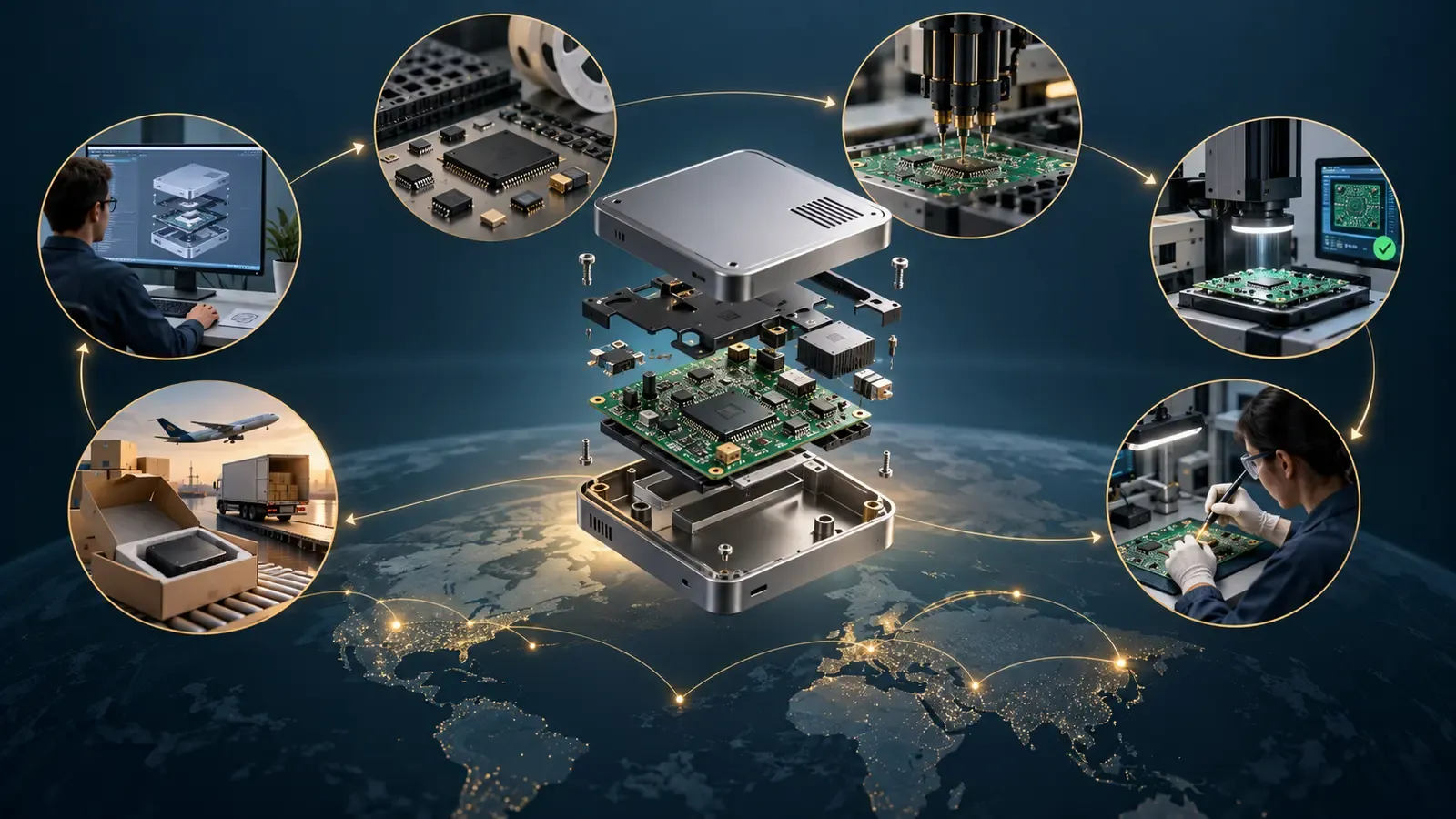
The short answer
An electronics factory gains control when every commercial, engineering, material, production and quality decision refers to the same product and order identity. The objective is not a larger database. It is a connected operational record that shows which revision was promised, which components were approved and consumed, what happened at each process, which exceptions were accepted, and what can safely ship.
That is the practical purpose of electronics manufacturing ERP: to turn hundreds of local decisions into one defensible factory truth.
The product is simple only from a distance
A customer sees one finished device, board or assembly. The factory sees a forecast, quotation, BOM, approved manufacturer list, engineering revision, purchase plan, incoming lots, work orders, programmes, tooling, component reels, serial numbers, test results, repairs, certificates and delivery commitments.
Each object may be accurate by itself and still conflict with the others. Purchasing can order the correct internal part against an obsolete manufacturer part. Production can build the correct quantity to yesterday’s BOM. Quality can release units that passed final test but required unrecorded rework. Sales can report a delivery date that ignores a subcontract operation.
The danger is not usually a complete absence of information. It is information whose relationships have broken.
A connected factory begins with identity
Operational control depends on stable identities for product, customer revision, component, manufacturer part, material lot, work order, unit or batch, process step, defect and shipment. These identities do not need to be complicated. They need to be unambiguous and consistently used.
When an engineer releases a change, the system should identify affected demand, open purchase orders, inventory, kits, work in progress and instructions. When a reel is issued, its lot and status should remain attached to the consuming job. When a serialised unit is repaired, the original failure, replaced component, technician action and retest should remain part of that unit’s history.
Without these links, teams reconstruct context from email, spreadsheets, labels and memory. That reconstruction becomes slower precisely when the decision is urgent.
Engineering truth must reach execution
The BOM is often described as the product recipe, but a released electronics product needs more than quantities and item codes. It may include manufacturer restrictions, approved alternates, reference designators, firmware, programmes, test specifications, effectivity rules and customer-specific documents.
An engineering change becomes real only when its consequences are visible. The practical questions are immediate: may the existing kit still be used; should a purchase order be changed; which work orders require the new revision; must completed units be inspected; and who is authorised to accept deviation?
The cluster article The BOM Changed. The Purchase Order Didn’t. examines how engineering change control should connect release decisions with procurement and production.
Availability is not the same as readiness
An ERP screen can show enough components on hand while the line remains unable to start. Some quantity may be reserved for another customer, under incoming inspection, stored at another site, in an unsuitable package, below moisture-control requirements or tied to an unapproved manufacturer part.
Readiness is therefore conditional. A production kit is ready only when the required quantity, revision, approval, location, quality status and time window agree. The system should expose those conditions before the work order reaches the line.
The Components Are in Stock. Why Isn’t the Kit Ready? separates accounting availability from executable material readiness.
A matching part number can still carry different risk
Electronics manufacturers buy into a component market shaped by allocation, lifecycle change, customer approval and substitution pressure. Two parts that appear equivalent commercially may differ in manufacturer, package, revision, date code, country of origin, compliance status or performance history.
An approved manufacturer list is not a static attachment. It is an operational rule that should influence quotation, sourcing, receiving, allocation, issue and traceability. The factory must know not only what internal part was used, but which actual manufacturer part and lot entered which products.
The Part Number Matches. The Manufacturing Risk Does Not. explores how approval and genealogy protect the factory from hidden substitution.
The schedule must describe an executable sequence
A schedule that considers only work-order date and machine hours is incomplete. SMT execution may depend on reel availability, feeder setup, programme release, stencil, tooling, maintenance state, operator skill, inspection capacity and downstream test.
One missing reel can trigger a sequence change. That change may increase setup time, move another customer’s order, overload a downstream process and consume material reserved elsewhere. If scheduling and execution are disconnected, planners keep moving colourful bars while supervisors manage the real constraint manually.
One Missing Reel Moved the Entire SMT Plan. shows how material and resource readiness should shape the production sequence.
Traceability must survive the exception route
Most systems look strongest on the standard path. A unit is issued, assembled, tested and completed. Reality introduces splits, partial quantities, substitutions, repairs, retests, subcontract operations and concessions.
Those exceptions are exactly where evidence matters. A serial number should remain connected when a board leaves the normal route for diagnosis. If a component is replaced, the old and new identity should be recorded. If the unit passes after repair, the release should not erase the failure history.
Does the Serial Number Survive the Rework Bench? follows the product genealogy through failure, repair and release.
Final yield can hide the economics of quality
A production lot may reach its shipment quantity and final pass target while absorbing repeated inspection, touch-up, component replacement and engineering attention. Final yield alone can therefore reward recovery without exposing the cost of instability.
Management needs first-pass yield, defect recurrence, repair labour, replaced material, retest capacity and delay connected to the same product, revision, line and job cost. The purpose is not to blame technicians. It is to distinguish a process that makes good units directly from one that produces acceptable units through expensive rescue.
The Yield Looks Good. The Rework Cost Says Otherwise. connects quality evidence with operational and commercial performance.
Customer visibility requires evidence, not optimism
An order status is credible only when its milestone meaning is shared. “In production” might mean material allocated, a work order released, SMT started, final assembly underway or simply that the order is somewhere inside the factory.
Customers need an answer appropriate to the promise: what has been completed, what remains constrained, what quantity is releasable, and whether the committed shipment date still has evidence behind it. This becomes harder when production crosses plants or subcontractors.
The Customer Asked Where the Order Is. Which Answer Is True? proposes milestone-based visibility across the extended operation.
Build one operational thread
The strongest design does not force every department into one giant screen. It allows each team to work through the decisions it owns while preserving the links between those decisions.
Sales owns customer demand and promise. Engineering owns product definition and change. Purchasing owns supply actions. Warehouse owns material identity, condition and movement. Production owns execution evidence. Quality owns disposition and release. Finance owns value and cost. Management needs the connected outcome.
ERP provides the commercial and planning backbone. MES records the execution detail. Barcode, machine and test integrations improve speed and granularity. Analytics can reveal recurring constraints. Their value depends on shared identities and controlled events, not on the number of interfaces installed.
Design around decisions, not data collection
Every transaction should protect a decision. Receiving captures manufacturer, lot and inspection status because allocation depends on them. Material issue captures the reel because genealogy and remaining balance depend on it. A defect record captures location and cause because containment and improvement depend on them.
When a field has no defined user or decision, it becomes administrative weight. When a decision relies on information that is not captured, people create a shadow process. Both conditions deserve redesign.
A practical workshop can map five questions for each critical event:
1. What decision is being made?
2. Which identity and status make it safe?
3. Who owns the decision?
4. What downstream record must inherit the result?
5. How will an exception be handled without losing history?
This approach is more useful than starting with a list of screens.
Make exceptions visible before they become emergencies
An electronics factory does not need every event to proceed automatically. It needs deviations to become visible early enough for an authorised person to decide.
A substituted component, late supplier confirmation, incomplete kit, changed programme, failed test or missed subcontract date should produce a controlled exception with owner, consequence and resolution. Email may notify people, but the outcome belongs in the operational record.
Exception age matters. A shortage discovered during planning has options. The same shortage found after the line changeover has cost. Dashboards should therefore show unresolved decisions and their impact, not only historical totals.
Connect commercial value to operational evidence
The decision thread should not end at quantity and status. It should also explain value. A component substitution may protect delivery while changing purchase cost. An engineering revision can create obsolete inventory. A line recovery may achieve output through overtime, extra setup and premium freight.
When financial results appear weeks later, the operational cause is often difficult to reconstruct. Link important variances to the same order, revision and exception identities while the context is current.
This does not require every operator to make an accounting entry. Operational events can feed clear cost categories: material variance, scrap, rework, subcontract, overtime, expediting and warranty exposure. Finance then validates value while operations retains cause.
Product and customer profitability becomes more useful when it reflects the actual route taken, not only the standard route that was planned.
Treat master data as production infrastructure
The connected model depends on product, component, customer, supplier, routing and resource data that people trust. Duplicate items, vague units, inactive alternates and inconsistent site codes create operational friction even when the software works perfectly.
Assign ownership by decision. Engineering owns technical product structure. Supply teams own supplier relationships and lead-time evidence. Operations owns routing and resource assumptions. Quality owns status and disposition rules. Shared governance should resolve overlaps rather than leave every field to IT.
Measure recurring manual correction, rejected transactions, duplicate creation and exceptions caused by missing master data. These are not clerical defects. They are early indicators of risk in the production decision chain.
Govern changes with proportionate approval and history. A typo correction should not require the same ceremony as a new approved manufacturer, but both need a clear accountable owner.
Measure flow across departmental boundaries
Traditional reports divide performance by function: purchasing delivery, warehouse accuracy, machine utilisation, quality yield and shipment performance. Useful as they are, these measures can optimise one department while damaging the whole order.
High utilisation can create downstream queues. Early purchasing can increase exposure to revision change. A high final yield can conceal repeated rework. On-time supplier delivery can still miss production readiness because inspection or documentation is incomplete.
Cross-functional measures should include engineering-change exposure, kit readiness at release, first-pass yield, exception ageing, schedule adherence by constraint reason, rework cost and promise confidence. These measures show whether the decision chain is improving.
Start with one representative product family
Do not begin transformation by cataloguing every possible field. Select a product family with meaningful complexity and trace one recent order from quotation to shipment.
Compare the intended route with the evidence actually available. Identify where teams changed identifiers, re-entered information, waited for confirmation or made decisions outside the system. Include at least one engineering change, shortage, failed unit or subcontract event so the exception path is visible.
Then prioritise the links that protect risk and flow: revision to demand, approved part to receipt, lot to issue, serial to test, defect to repair, completion to shipment. Define ownership and success measures before adding automation.
The result should be a smaller number of clearer decisions, not simply more transactions.
Frequently asked questions
Is electronics manufacturing ERP different from generic ERP?
The financial and commercial foundations may be similar, but electronics operations require deeper control of BOM revisions, approved manufacturer parts, component lots, serial genealogy, SMT execution, test and rework. Industry fit determines how naturally those events remain connected.
Does every product require unit-level serialisation?
No. Traceability depth should reflect customer, regulatory, reliability and commercial risk. Some products can be controlled by batch; others need unit-level history. The chosen model must support credible containment and response.
Can spreadsheets remain part of the process?
They can support analysis and temporary planning, but critical identity, status and approval should return to the controlled operational record. A private spreadsheet should not be the only place where the factory knows which revision or material is valid.
Where should implementation begin?
Begin with a representative order and the decisions that most affect customer promise, quality and material risk. Establish shared identities and ownership before attempting advanced automation.
What is the role of Mars?
Mars connects electronics and EMS workflows across ERP, MES and operational insight. Its value is the industry structure around engineering change, materials, production execution, traceability and multi-site control.
One product, one defensible history
The finished assembly is the visible outcome of hundreds of invisible decisions. When those decisions remain connected, the factory can answer difficult questions quickly: which revision was built, which parts were used, why the schedule changed, what failed, what was repaired, what it cost and when the order can ship.
That is more than reporting. It is the operating foundation for reliable electronics manufacturing.