

One Variation, Four Versions of the Truth
A variation affects scope, programme, cost and billing at different speeds. One controlled record prevents commercial entitlement from separating from delivery reality.
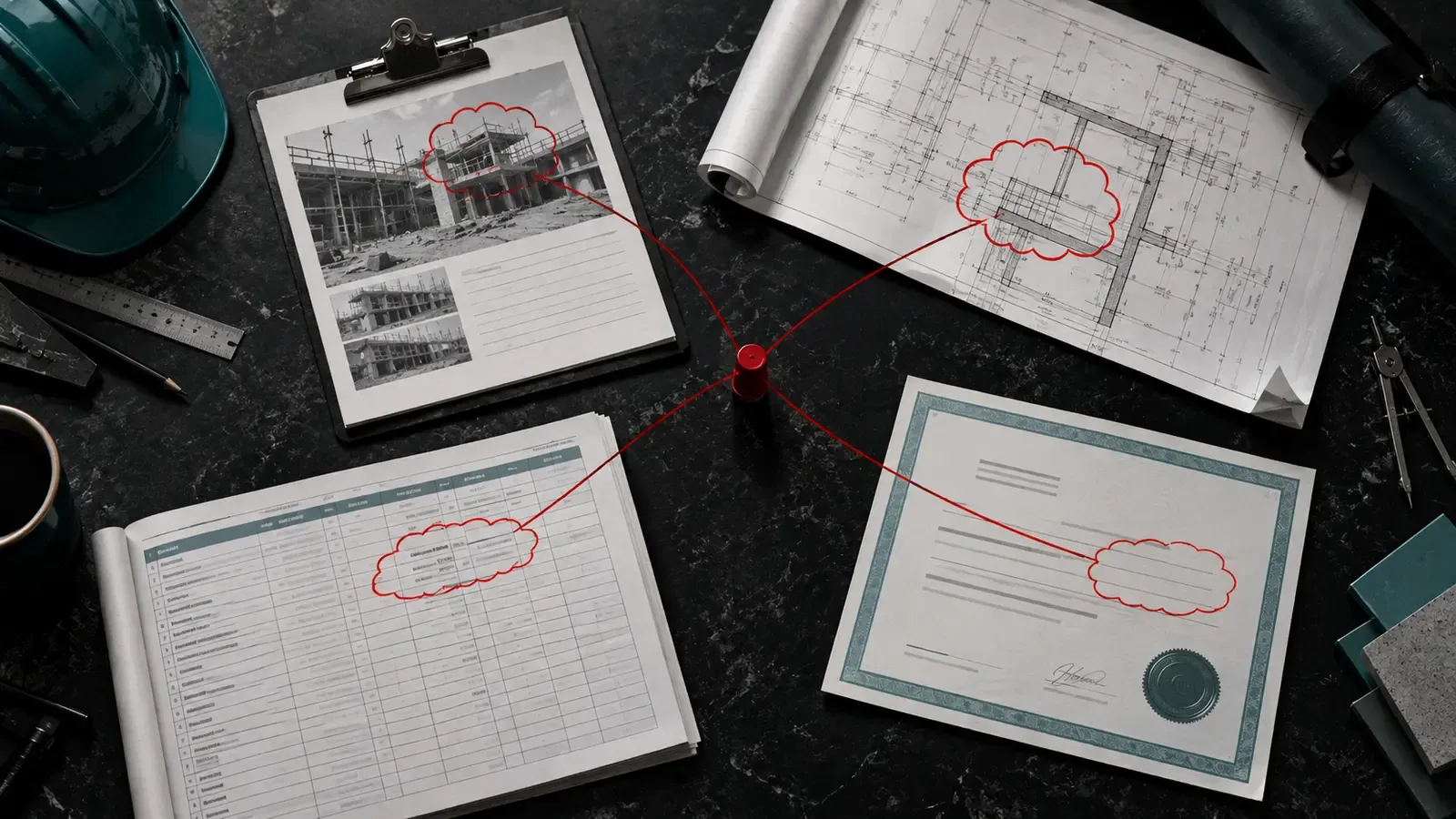
The short answer
A variation is not merely an extra line on a contract. It is a coordinated change to what will be delivered, when it can be delivered, what resources it consumes, what the contractor expects to recover and what the client has accepted.
Separate logs hide timing. Management may see a healthy approved-variation total while substantial instructed work remains unpriced, unapproved or unbilled.
A project example
A client requests a revised ceiling layout. The site instruction arrives first, design issues a sketch, the planner adds two nights of work, procurement orders different supports, and commercial prepares a quotation. Each action uses a different reference. By the time approval arrives, actual cost has already landed and the forecast still treats the work as risk.
The immediate temptation is to ask one team to update its spreadsheet. That may fix the next meeting, but it does not fix the underlying control. The project needs a shared identity for the event, compatible structures across disciplines and a clear rule for when a status becomes trusted.
This issue is one part of the wider framework in The Project Is On Budget. Which Version of the Budget?, which connects tender assumptions, approved change, commitments, site evidence, forecast margin and cash.
Why the apparent status is misleading
A status such as ordered, approved, complete, claimed or on budget compresses many conditions into one label. The label becomes dangerous when users interpret it as proof of conditions that were never checked. Good project control separates the component signals and shows the dependency between them.
The distinction is especially important at handovers. Tender passes to delivery, design passes to procurement, procurement passes to site, site progress passes to commercial valuation, and commercial valuation passes to finance. Every handover can remove context. A connected model carries the original reference, the current state and the consequence forward.
What connected control changes
Connected control does not mean forcing every discipline into one screen. It means that tender, contract, programme, procurement, site and finance records share a stable project identity and a governed structure. A project manager can move from an exception to the source transaction, document, decision and owner without exporting five reports and rebuilding the story.
For construction and engineering enterprises, the Saturn platform is designed around that project-centric flow. Tender and contract information becomes operating context; project and site events update cost and schedule visibility; and financial consequences remain attached to the work that created them. Integration matters because the commercial answer and the operational answer are usually two views of the same event.
The practical goal is earlier action. A late supplier milestone, unapproved instruction, productivity change or missing certification should alter the relevant forecast while someone still has choices. If the information reaches management only through the month-end report, the system documents history rather than controlling the project.
Build one evidence chain
The minimum useful evidence chain for construction variation management contains:
- originating instruction and scope narrative;
- quotation, entitlement and approval status;
- programme and resource impact;
- commitments, actual cost and forecast exposure;
- billing certificate and cash status;
These elements should not become another checklist maintained beside the transaction system. Each status needs a source, an owner and a timestamp. Where judgement is necessary, the assumption should be explicit. Where a figure changes, the movement should be visible rather than overwritten.
That discipline creates traceability without making the process bureaucratic. Teams can spend less time proving which spreadsheet is newest and more time deciding what to do. It also makes management review more constructive: the discussion begins with the exception and its consequence, not with reconciliation.
A practical operating rhythm
Use three horizons. The project team manages immediate constraints every day. Package owners refresh progress, commitments and remaining effort each week. Management reviews margin, cash, major risk and change at an agreed monthly cut-off. The same underlying records support all three horizons, while the level of detail changes for the audience.
Do not wait for perfect data. Start with the recurring exceptions that cause delay, margin leakage or cash uncertainty. Define the decision each signal supports, then capture only the evidence needed to make that decision. A smaller set of trusted statuses is more valuable than a comprehensive dashboard populated by stale assumptions.
Ownership also matters. Every exception should identify who can resolve it, the next action, the required date and the consequence of inaction. “Open” is not a management state. A useful open item explains what is waiting and how it affects scope, programme, cost, quality, safety or cash.
Keep the coding structure aligned
Many control failures begin below the dashboard. The programme uses activities, the estimator uses bill items, procurement uses packages, site teams use locations and finance uses cost codes. If those structures have no deliberate mapping, the organisation cannot compare progress with cost without manual interpretation.
Alignment does not require one universal code for every purpose. It requires stable relationships. A work package can connect to programme activities, cost accounts, purchase orders, variations and site locations while each discipline retains the detail it needs. The mapping should be defined during mobilisation and governed when scope changes.
This makes exception reporting more precise. Instead of saying that “materials are late” or “labour is over,” the team can identify the affected package, location, milestone, budget allowance and customer consequence. That precision shortens the distance between insight and action.
Design controls for adoption
A technically complete workflow will fail if site and project teams experience it as duplicate administration. Capture information at the point where work already happens, reuse approved master data and remove parallel reports once the connected view is trusted. Mobile-friendly evidence, simple ownership fields and clear exception queues usually create more value than a dense form.
Governance should also define who may change a baseline, approve a forecast assumption or close an exception. Permissions alone are not enough; the business needs an audit trail and a review rhythm. When people understand how their update affects procurement, billing, margin or management decisions, data quality becomes part of operating the project rather than a separate compliance task.
Five implementation moves
1. Create one variation identity at first notice, not at final approval. This turns a general intention into a repeatable control and preserves the commercial reason behind the number.
2. Link drawings, instructions, quotations and decisions to that identity. This turns a general intention into a repeatable control and preserves the commercial reason behind the number.
3. Separate submitted, approved, forecast and billed values. This turns a general intention into a repeatable control and preserves the commercial reason behind the number.
4. Capture time impact and affected work packages. This turns a general intention into a repeatable control and preserves the commercial reason behind the number.
5. Escalate ageing instructed work before evidence is lost. This turns a general intention into a repeatable control and preserves the commercial reason behind the number.
The sequence should follow value, not departmental boundaries. Choose one live project or work package, connect its current records and compare the result with the existing review process. The gaps will show which definitions, approvals and integrations matter most. Expand only after the first flow is trusted by operations, commercial and finance.
What management should measure
Outcome measures such as final margin and completion date remain essential, but they arrive late. Pair them with leading indicators:
- instructed-not-priced value;
- submitted-not-approved age;
- approved-not-billed value;
- variation margin movement;
- time from instruction to commercial notice;
Trends matter more than isolated values. A forecast that moves for a documented reason is healthier than a perfectly flat forecast that absorbs surprises at completion. Management should challenge unexplained stability, stale updates and optimistic assumptions with the same energy used to challenge visible overruns.
The most useful review question is: Can one variation record explain scope, time, cost, entitlement and cash without reconciliation? It invites evidence, exposes different definitions and directs attention to the next decision.
Frequently asked questions
Why are spreadsheets not enough for this control?
Spreadsheets are valuable for analysis, but they rarely preserve workflow, approval, source transactions and cross-functional ownership. When several teams maintain separate copies, reconciliation becomes part of every decision. A connected system can still export data for analysis while keeping the governed record intact.
Does connected project control remove professional judgement?
No. Construction forecasts require judgement about productivity, risk, entitlement and remaining work. The system should make that judgement visible, dated and attributable so others can understand the assumption and see when it changes.
Should every site update data in real time?
Not every field needs real-time capture. The update frequency should match the decision. Safety or access constraints may need immediate action; productivity and package forecasts may be daily or weekly; formal financial reporting may follow a monthly close. The important point is that each status has a known freshness standard.
Where should a contractor start?
Select one recurring management question that currently requires manual reconciliation. Connect the small set of tender, contract, site and finance evidence needed to answer it. Prove the flow on one live project, agree the definitions and then scale it across the portfolio.