

The Quality Record Is Complete. Does It Prove the Right Work Was Done?
Quality records only protect the project when they are tied to the correct location, material, test, revision and installed condition. Complete paperwork without traceability can still fail at handover.
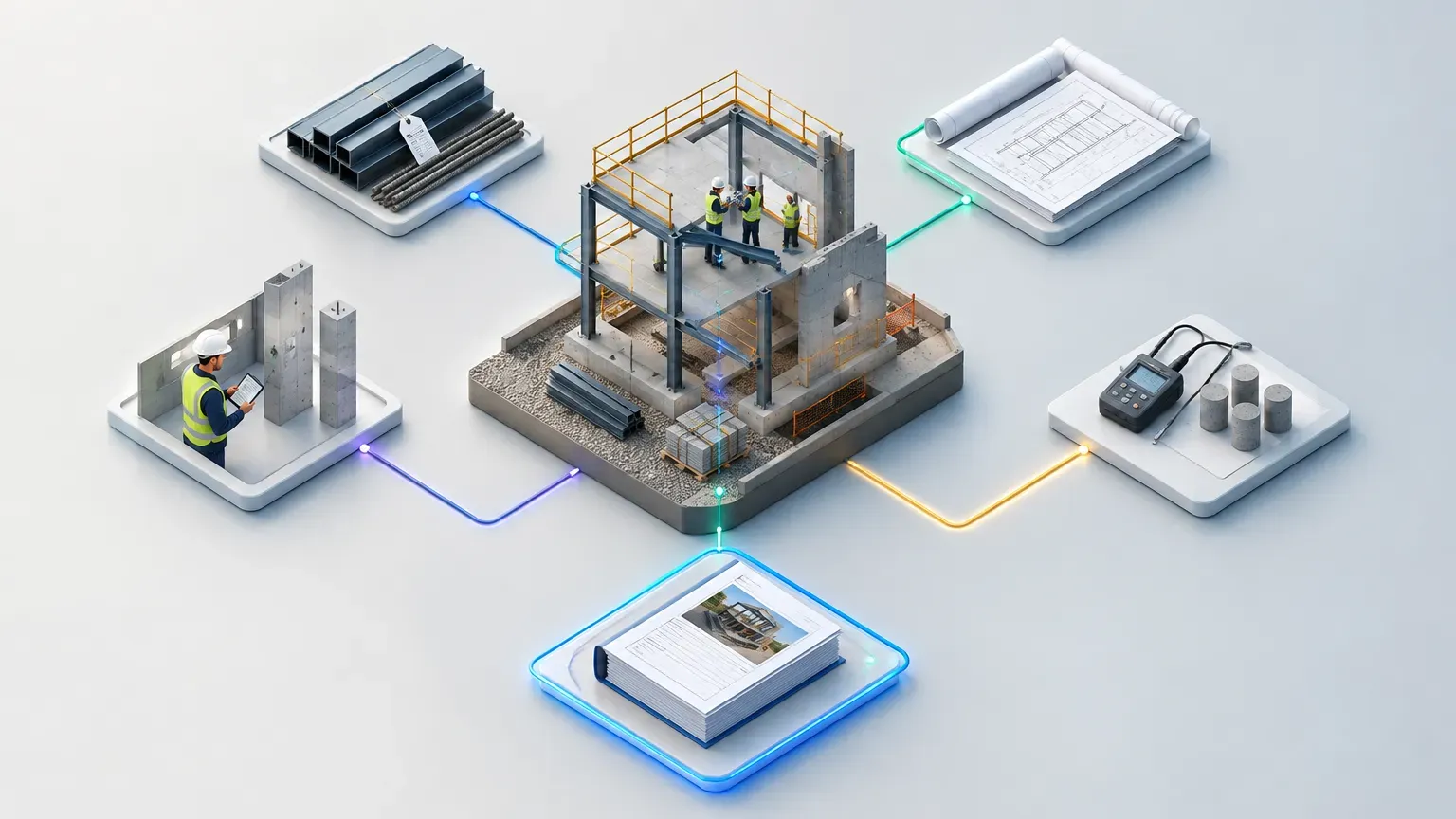
The short answer
A quality record is useful only if the project can prove what physical work it belongs to.
A signed checklist, test certificate or inspection form may be complete on paper and still be weak evidence if it cannot be traced to the correct location, material, revision, asset or installed condition.
At handover, the question is not “do we have the document?”
It is “can we prove this document supports this piece of work?”
Paperwork volume can create false confidence
Large projects generate thousands of records.
A full document repository looks reassuring.
The risk is assuming completeness means traceability.
A test certificate may exist.
But which installed material does it cover?
A photograph may show compliant work.
But where was it taken?
An inspection form may be signed.
But which revision was used?
A quality system becomes valuable when the evidence can travel both ways.
From the installed asset to the supporting record.
And from the record back to the physical work it proves.
Location is one of the most important pieces of quality data
Construction is spatial.
The same component, detail or material can appear hundreds of times.
Without reliable location, records lose meaning quickly.
“Level 3” may be too broad.
“Area A” may not survive into the client’s asset structure.
Different teams may use different naming conventions.
A strong project decides early how locations will be identified across drawings, inspections, photos, tests and handover records.
This may seem like administrative detail.
At closeout, it becomes the difference between finding evidence in seconds and searching for hours.
Material traceability becomes critical when one batch creates doubt
Most material moves through the project without issue.
Traceability becomes valuable when something goes wrong.
A test fails.
A certificate is questioned.
A batch is recalled.
A supplier identifies a quality concern.
The project then needs to know where the affected material was installed.
If the record cannot connect receipt, batch and location, the project may have to inspect or replace far more work than necessary.
This is one reason quality traceability is not simply a handover requirement.
It can reduce the physical scope of a problem while construction is still active.
Revision traceability protects the meaning of acceptance
A signed inspection is only useful if the project knows what information the work was checked against.
Design changes complicate this.
If a drawing is revised after inspection, does the accepted work still comply?
Did the revision affect that location?
Does the inspection remain valid?
Without revision traceability, the project may have a signed acceptance record whose technical basis is unclear.
The wider completion-control process becomes stronger when accepted work carries enough context to survive later design change.
That does not require attaching every possible document to every inspection.
It requires a controlled relationship between the work, the information and the evidence.
Photos are powerful evidence when they are not anonymous
Photographs can prove conditions that later become hidden.
Reinforcement before concrete.
Services before ceiling closure.
Waterproofing before finishes.
Connections before enclosure.
The problem is the anonymous photo.
A close-up may clearly show good workmanship while revealing nothing about where or when the image was taken.
Useful photographic evidence should carry enough context to identify the location, date and work it supports.
Again, the goal is not more data.
It is evidence that remains meaningful months later when the original supervisor is no longer standing beside the work.
Quality evidence should mature with the work
Projects sometimes postpone document clean-up until the end.
That creates a dangerous gap.
Physical construction moves forward while the record lags behind.
By handover, the team is trying to reconstruct months of evidence.
A better model is progressive maturity.
As work becomes inspected and accepted, its quality record should move toward completion too.
Missing items can then be resolved while access and people are still available.
This reduces the closeout spike and improves confidence in the true completion status.
Traceability turns quality records into asset information
At handover, the record begins serving a different user.
The client may need to know what was installed, where, how it was tested and what maintenance or warranty conditions apply.
The quality evidence becomes part of the asset story.
This is why traceability should not be designed only for the contractor’s internal filing.
The record should survive the transition from project delivery to asset operation.
That gives quality control a longer life than the construction period.
Traceability also improves the speed of problem-solving during construction.
If a test result is questioned, the project can identify the affected locations quickly.
If a material certificate is missing, it can see which installed work depends on it.
If a revision changes, it can determine which inspected areas may need review.
This is much more powerful than treating quality records as passive archives.
The record becomes an active navigation system through the project’s physical history.
Traceability becomes even more important when records pass through several organisations.
The supplier may create the material certificate.
The subcontractor may hold the installation checklist.
The main contractor may hold the inspection request.
The consultant may issue the acceptance.
At handover, the client expects one coherent story.
If those records use different references, locations or naming conventions, the project can have all the documents and still struggle to prove the chain.
This is why common project identifiers matter.
Location, package, asset, drawing and material references should be consistent enough that information can be joined without manual interpretation every time.
The goal is not a perfect master-data programme.
It is reducing ambiguity.
That becomes particularly valuable when one record changes.
A revised certificate, a replaced item or a corrected test result should allow the project to understand which installed work is affected.
Without traceability, the safest response is often to review a much larger scope than necessary.
The quality record can also support future maintenance.
If an operator later needs to know which product was installed in a location, or which test result applies to an asset, a traceable handover record turns construction evidence into usable operational information.
That creates lasting value from records the contractor already needed to produce.
It also improves project closeout because the team can test completeness by following the asset rather than by counting files.
Does this installed item have the evidence required for acceptance and operation?
That is a much stronger question than asking whether the document folder is full.
Quality documentation becomes meaningful when it follows the asset, not when it merely fills the archive.
A traceable record also changes the economics of audit and client review.
When evidence is easy to navigate, the project can answer questions quickly.
When records are disconnected, every query becomes manual investigation: search the folder, ask the subcontractor, check a drawing, identify the location, confirm the batch.
That effort is rarely visible in the construction budget, but it can consume substantial time near completion.
Good traceability reduces that friction.
It also makes selective assurance possible. If the client wants to review one asset or area, the project can produce the relevant evidence without exposing the entire document archive to manual search.
This is especially valuable on complex engineering projects where the amount of quality information can be enormous.
The objective is not more paperwork.
It is a record structure that allows the right evidence to be found and trusted when the project needs it.
Where Epicor Saturn fits in quality traceability
Epicor provides the enterprise-grade ERP foundation for purchasing, approvals, material records, finance and governance. Epicor Saturn adds the construction and engineering project layer that relates those enterprise records to project locations, workfronts, subcontract packages, inspections and closeout.
That connection helps quality evidence remain attached to the project context that gives it meaning.
Epicor Saturn provides the construction-industry project structure while Epicor supplies the enterprise-grade transactional foundation underneath it. Explore Epicor Saturn for construction and engineering.
Frequently asked questions
Does every quality record need asset-level traceability?
Not always. The level should reflect project, contractual and risk requirements.
Why is location data so important?
Because identical materials and details can appear across many areas, making records ambiguous without location.
Are site photos enough for quality evidence?
They can be valuable, but they need location, date and context to remain useful later.
When should quality records be completed?
Progressively, as the work is inspected and accepted—not only at final handover.